
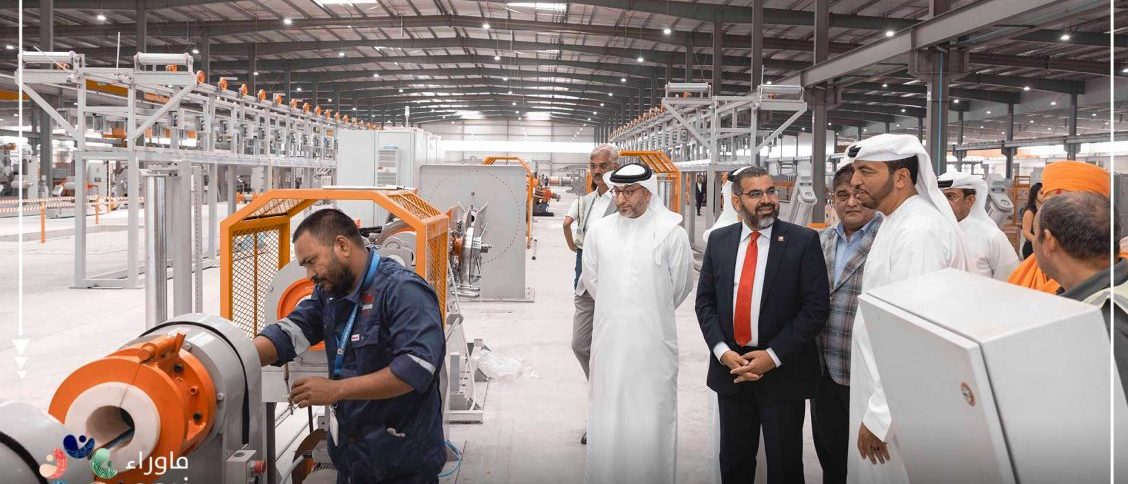
The tighter the political grip in Saudia Arabia becomes, the louder the promises of “economic growth,” “record-breaking contracts,” and “unprecedented development booms.” It no longer matters whether these projects are real or imaginary — what matters is the glossy headline, crafted to sell the illusion of a thriving economy. Meanwhile, the reality beneath is weighed down by debt, inflation, and disguised unemployment.
In this climate of showmanship, major companies like NMDC Energy parade astronomical figures and fantastical growth projections — as seen in CEO Ahmed Salem Al Dhaheri’s recent interview with CNN Business Arabic.
Hollow Numbers and an Empty “Boom”
Al Dhaheri announced that the company expects continued growth in the second half of 2025, claiming contract bids had reached AED 66 billion (approx. $18 billion), and that onshore projects had grown from 10% of revenue in 2023 to 43% today.
But the fundamental question remains:
What is the real return on these contracts?
How much has been delivered on the ground versus remaining only on paper?
The interview offered no data on net profits, execution rates, or operational challenges — only lofty language, mirroring the rhetoric of Saudi Arabia’s Vision 2030: inflated ambitions propped up by structurally unsound economies.
Energy and Construction Giants as Tools of Political Cover-Up
With mega-projects like NEOM stalling and the Saudi budget deficit growing, Gulf governments increasingly turn to the private sector for promotional partnership. Through companies like NMDC Energy, they chant slogans of progress and flood the media with headlines about billion-dollar deals — most of which never materialize.
Far from being an exception, NMDC Energy exemplifies how “development projects” are used as facades to push expansionist policies with no true productive foundation.
How many past contracts have actually been fulfilled?
What percentage of these deals include local workforce participation?
And how much of this outsourced work goes to foreign subcontractors, while Gulf citizens are sidelined from real employment and skills development?
Foreign Labour In, Local Talent Out
Despite all the talk of “national visions,” most of the firms awarded billion-dollar deals still rely heavily on foreign labour — from technical staff to senior executives. Meanwhile, the Gulf citizen is increasingly turned into a spectator in his own homeland, invited only to attend the ribbon-cutting ceremonies.
True localisation isn’t a number on a report. It’s a tangible commitment to returning national wealth to the people.
When lucrative contracts primarily enrich foreign companies instead of developing the domestic economy, what we see is parasitic growth based on importation, not innovation.
Economic Journalism Without Accountability
The interview with NMDC Energy was published on CNN Business Arabic — a platform widely criticised for offering soft-focus coverage of Gulf regimes. This reflects a growing problem: the co-opting of global economic media into vehicles of disinformation.
Instead of critical analysis, we get PR:
No scrutiny of contract execution.
No questions about funding sources.
No exploration of project feasibility or legal frameworks.
The media, once the fourth estate, is now an active partner in the deception — particularly when it comes to projects branded under “economic transformation” and “urban renaissance.”
From NEOM to NMDC: Inflated Narratives, Invisible Results
What’s unfolding with NMDC Energy is a smaller version of the same charade behind The Line, NEOM, and Riyadh Green. A media spectacle with no substance on the ground.
All announcements follow the same script:
“We expect…”
“We plan…”
“It was announced…”
Yet they consistently fail to answer the only question that matters:
What has actually been achieved?
And at what social and economic cost?
Many of these projects are quietly shelved, restructured, or abandoned after years of costly PR — with no transparency or accountability.
Transparency Gaps and Citizens Excluded from Decision-Making
The Gulf’s industrial sector — including energy and construction — suffers from a chronic lack of transparency.
Contracts are frequently awarded behind closed doors.
Project results are rarely disclosed.
Performance is not independently audited.
Public spending goes unexamined.
Losses go unreported.
And citizens bear the cost through sovereign funds with no say and no compensation.
Mega-Projects Are No Substitute for Social Justice
Those who announce AED 66 billion in contracts must also answer:
● How many jobs were created?
● How many families benefited?
● How many schools or hospitals were built?
● How much debt was paid down, rather than created?
Projects should be judged not by size but by their real impact.
Expansion that ignores people’s basic needs isn’t development — it’s a theatrical display used to mask systemic failure.
Selling the Future Through Temporary Contracts
Anyone who repeatedly announces tens of billions in deals without delivering tangible results has no genuine development plan.
They are simply buying time, buying silence, and buying media covers — with public money.
An economy built on illusion cannot survive a real crisis.
And a citizen excluded from these projects is a citizen excluded from justice, progress, and the future.
So what kind of economy excludes its own people?
What kind of growth produces no public good? The answer: MBS’s economy. And the Gulf’s privatisation mirage.