
What is unfolding inside NEOM can no longer be dismissed as routine restructuring, technical revisions, or strategic recalibration. The repeated cancellations, withdrawals, and contract terminations now emerging from Saudi Arabia’s flagship mega-project point to something far more serious: the gradual internal dismantling of what was once marketed as the most ambitious urban project on earth.
The decision to cancel the high-speed transport link connecting Oxagon and The Line is not merely the termination of another infrastructure contract. It is a major blow to the very concept behind NEOM itself. A project originally presented as a fully integrated futuristic ecosystem is now beginning to lose the infrastructure that was supposed to hold it together.
The seriousness of the cancellation lies not only in the fact that roughly 20% of the project had already been completed before work was halted, but in what the decision symbolically reveals. Even the strategic transport systems once considered essential to connecting NEOM’s core districts are now being abandoned under mounting financial pressure and shifting priorities.
When Saudi Arabia begins canceling the infrastructure meant to connect its “city of the future” internally, the conversation is no longer about redesigning plans. It is about dismantling the project from within.
The situation becomes even more revealing given that the cancellation follows other terminated contracts involving the same contractor, including major dam projects. Italian construction giant Webuild has effectively exited NEOM altogether, leaving behind unfinished sites, canceled agreements, and workers facing layoffs, while Saudi authorities absorb billions in sunk costs, compensation obligations, and unfinished infrastructure.
A Future City Without a Functional Core
When NEOM was first announced, Saudi authorities described it as a revolutionary urban model built around seamless integration, smart mobility, and ultra-fast connectivity between its futuristic districts.
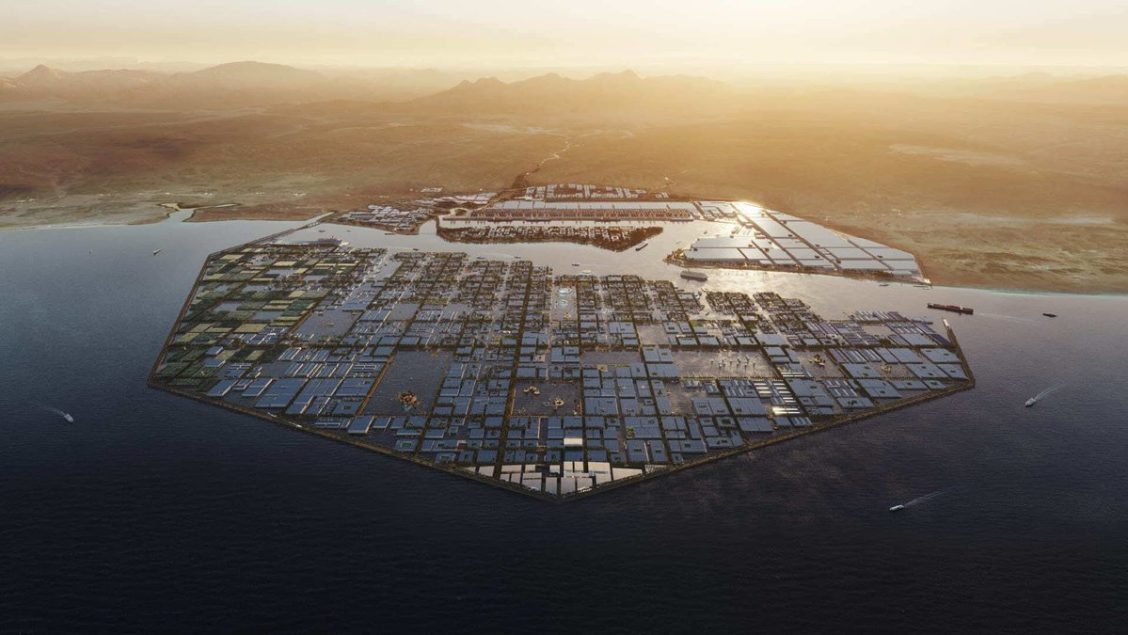
The Line, Oxagon, Trojena, and other developments were marketed not as isolated projects, but as components of a unified system supposedly capable of redefining modern urban life globally.
What is happening now exposes the opposite reality.
Canceling the high-speed rail connection fundamentally undermines the operational logic behind the project itself. A futuristic city cannot function without the infrastructure that allows its components to operate as one coherent system. The cancellation raises an increasingly unavoidable question: how can Saudi Arabia continue selling NEOM as the city of the future while dismantling the very transport systems required to make it viable?
The deeper issue is that NEOM increasingly appears to have been built around marketing spectacle rather than realistic long-term planning. Each district was announced as an individually revolutionary concept, yet without a financially sustainable or operationally coherent framework capable of integrating the entire project into a functioning city.
The result is a landscape of disconnected mega-structures rather than a living urban ecosystem.
Despite tens of billions already spent, NEOM still lacks a complete operational infrastructure, a real resident population, or a functioning economic system. What remains instead are stalled construction sites, shrinking ambitions, and a growing list of canceled projects.
And every cancellation creates additional financial damage. Saudi Arabia is not simply halting projects — it is paying termination costs, compensation packages, workforce reductions, site closures, and absorbing billions already spent on infrastructure that may never be used.
“Project reassessment” has effectively become a new mechanism for burning money rather than saving it.
Saudi Arabia’s Era of Unlimited Spending Is Ending
The cancellation of the transport link cannot be separated from the broader financial pressures now confronting Saudi Arabia itself.
For years, the kingdom spent as though oil revenues and sovereign wealth were limitless. Futuristic cities, entertainment megaprojects, global sporting events, tourism campaigns, gaming investments, and international acquisitions were launched simultaneously while oil remained the actual source financing nearly all of it.
But declining oil prices, growing regional instability, rising military expenditures, and mounting debt have forced a painful reality into the open: Saudi Arabia cannot continue financing every mega-project at the scale originally promised.
That is why the language of “historic transformation” has increasingly been replaced by discussions of “efficiency,” “prioritization,” and “cost optimization.”
Canceling a project of this magnitude after significant progress had already been made demonstrates that the crisis is no longer theoretical. Saudi authorities are no longer merely trying to improve projects — they are trying to contain escalating financial damage.
Even the Public Investment Fund, once promoted as the unstoppable financial engine behind Saudi Arabia’s transformation, now appears forced to reassess its commitments under pressure from liquidity constraints, rising obligations, and expanding debt burdens.
The irony is unavoidable: the projects once presented as symbols of the future are becoming the first casualties of Saudi Arabia’s economic reality.
When the state begins dismantling the internal infrastructure of NEOM itself, the priority is no longer “building the future.” It is preventing the financial bleeding from accelerating further.
From “City of the Future” to Monument of Overreach
What is happening inside NEOM today is no longer simply an engineering or financial setback. It is a broader exposure of the governing model Mohammed bin Salman attempted to impose over the past decade — a model built around gigantic announcements, massive spending, centralized decision-making, and global media spectacle, but lacking transparency, institutional oversight, or realistic execution frameworks. Cities cannot be built through slogans alone.
And deserts do not become global urban capitals simply because billions are poured into them.
NEOM is increasingly becoming the clearest example of the limits of a system attempting to purchase the future through money and branding alone.
After tens of billions of dollars, the project still cannot produce a functioning city, while its key components continue collapsing one after another. Major contractors are exiting. Transport systems are being canceled. Plans are shrinking. Entire sections of the project are being delayed indefinitely.
The “city of the future” is gradually transforming into one of the largest examples of financial overreach in the modern era.
And these failures are no longer hidden internally. Every company withdrawal, every canceled contract, and every abandoned project sends another signal to global investors and financial markets that the urban revolution once marketed to the world is facing a deep structural crisis.
Saudi authorities may continue insisting publicly that NEOM remains alive and progressing. But the reality unfolding on the ground tells a very different story.
The project that was supposed to redefine the future is now struggling to maintain even the infrastructure needed to connect its own pieces together — while billions buried beneath the desert increasingly stand as a monument to the limits of power when it attempts to engineer the future through money alone.