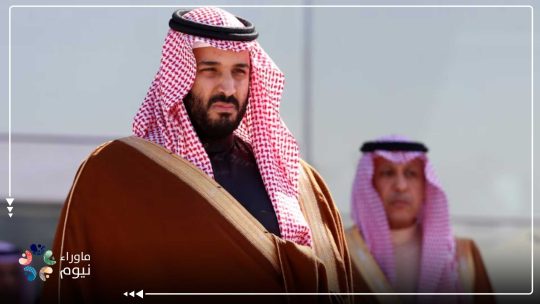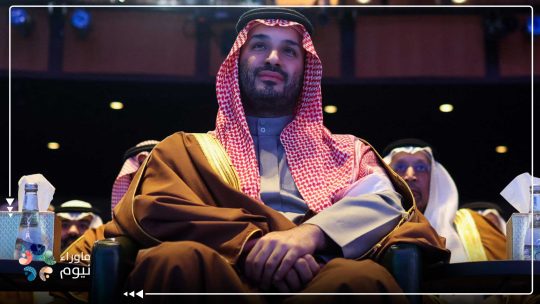


The latest Bloomberg leak about an imminent agreement between Donald Trump and Mohammed bin Salman—one that would grant the Saudi regime access to F-35 fighter jets—is not an ordinary headline. It is the newest chapter in a long-running saga of political dependency and military blackmail that has defined Riyadh–Washington relations for decades.
Bloomberg’s report, published on 14 November 2025 and citing a U.S. official, coincides with MBS’s upcoming visit to the White House. The choreography is familiar: Washington appears as the “grantor,” Riyadh as the “petitioner,” and behind the optics lies a deeper, structural reality. This deal is not about defence or security—it is entirely political, exposing the fragility of a Saudi regime that seeks external legitimacy after losing it at home through economic failure and escalating repression.
A parallel Reuters report on the same day adds fuel to the fire. Trump himself declared that the Saudis “asked me to look into it—they want to buy a lot of the ‘35’.” The sentence, though casual, reflects the essence of the relationship: the White House decides; the Saudi regime waits at the door. This is not a negotiation between equals—it is a marketplace where the buyer has no leverage and the seller knows the customer will pay anything.
To understand the true meaning of this potential deal, it is necessary to break down its political, economic, and military dimensions—far from the noise of official propaganda.
From the $142 Billion Arms Deal to the F-35: A Regime That Pays Anything to Stay Afloat
A Reuters report from 13 May 2025 revealed that the F-35 request was already on the table months ago as part of a colossal $142 billion arms package. Washington discussed the request but never approved it. Why now? And why does the same announcement reappear every time MBS approaches a high-stakes political moment—or the U.S. enters election season?
The answer lies in mutual needs, but not mutual trust.
The Saudi regime desperately needs a foreign “achievement” to mask the collapse of Vision 2030, the ballooning deficit, and the flight of foreign investors. Trump, meanwhile, needs a made-for-TV political win—another deal to showcase his supposed mastery of power.
The Pentagon itself is unconvinced. A mid-November 2025 AeroTime investigation revealed that U.S. officials fear the F-35’s ultra-sensitive technologies could leak to China through Saudi Arabia’s rapidly expanding tech partnerships. This concern alone shows that Washington does not view Riyadh as a strategic ally—it views it as a lucrative customer, nothing more.
Israel’s Military Edge: The Red Line MBS Will Pay for in Full
Any Arab state requesting the F-35 runs into the same immovable American doctrine: protecting Israel’s Qualitative Military Edge (QME). A Business Insider report in May 2025 highlighted that the sale would provoke immediate opposition from Israel and the U.S. Congress.
How does the Saudi regime expect to break through that wall?
American media suggests one answer: concessions.
Not financial concessions—political ones.
Concessions on foreign policy.
Concessions on regional alignment.
Concessions that pull the kingdom deeper into the orbit of U.S. and Israeli strategic interests.
Behind the scenes, an F-35 sale would mean accelerated normalization, intelligence-sharing, and security coordination that goes far beyond money. This is not a weapons deal—it is a political realignment with a military price tag.
The regime understands this perfectly. That is why it pursues the deal as a long-term political investment, even if the domestic and regional costs are enormous.
Between the Illusion of Power and the Reality of Failure: Does MBS Need a Stealth Jet—or Actual Legitimacy?
The harsher truth is this: the Saudi regime does not need a fifth-generation jet nearly as much as it needs a new story to sell its people.
Vision 2030 is stumbling.
Debt is rising.
Unemployment grows.
Foreign investors are fleeing.
Mega-projects are collapsing under delays and financial hemorrhaging.
And so the regime looks for a dramatic event—a spectacle—to reconstruct the image of a “powerful leader.” The F-35 is perfect for this purpose. It is more than a weapon. It is a symbol, a shiny object that can distract the public from the economic freefall.
But symbolism cannot hide structural reality.
What is the use of the most advanced fighter jet in the world if the state lacks:
- an independent military doctrine,
- a reliable defense industry,
- trained crews,
- and sovereign decision-making?
The same system that cannot complete a single mega-project without delays and cost explosions now pretends it can operate the most sophisticated aircraft on earth. This is not strategy. It is theatre.
Washington knows this. That is why it does not see Riyadh as a rising military power, but as a permanent customer—one who will always return for more.
Stealth Jets, Exposed Regime: The F-35 Will Not Hide the Collapse of MBS’s Project
The conclusion is unavoidable: an F-35 deal will not strengthen Saudi Arabia. It will tighten the regime’s dependency on Washington. It will not secure the kingdom. It will secure MBS’s political survival—temporarily, and at a massive cost.
A state that cannot build internal legitimacy will try to buy it abroad.
A state that fails economically will hide behind military toys.
And a state that fears its own people cannot claim sovereignty by purchasing jets.
The F-35 may be stealth.
But the crisis of the Saudi regime is visible to the naked eye:
authoritarian rule, economic mismanagement, vanishing transparency, and a permanent reliance on foreign protection.
No jet can fix that.
No jet can hide it.
And no jet can save a system that is collapsing from within.