

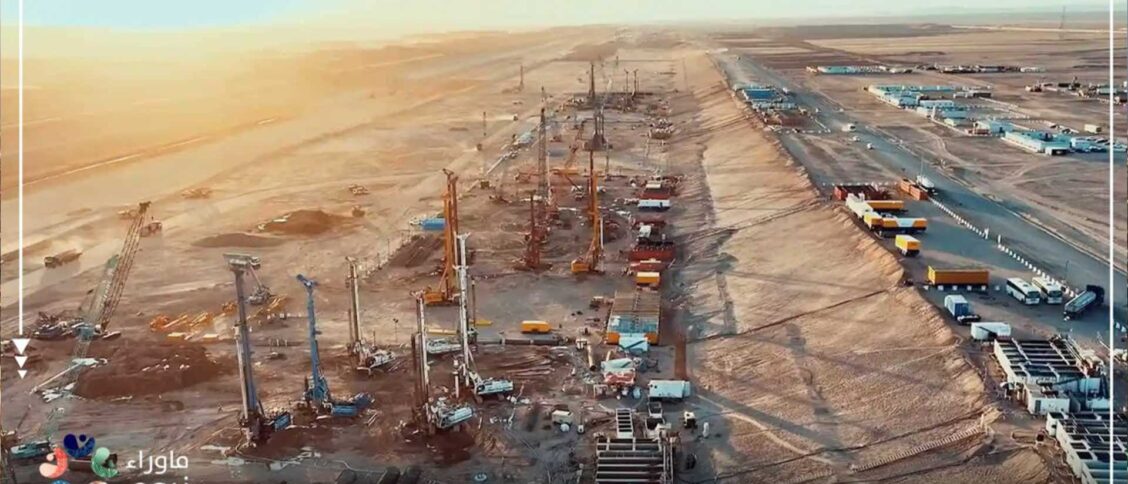
A hotel construction contract worth SAR 717 million has been cancelled in Diriyah just months after being awarded, while Saudi Arabia’s megaprojects face mounting financing pressures. At the same time, unverified reports alleging the arrest of NEOM’s former chief executive, Nadhmi Al-Nasr, and his son have reignited questions about accountability for major investment decisions.
Between implementation setbacks and uncertainty surrounding accountability, scrutiny is intensifying over Saudi Arabia’s ability to translate the promises of Vision 2030 into completed projects and measurable economic returns, rather than relying on ambitious announcements and management reshuffles.
The challenges are no longer limited to rising construction costs or delayed schedules. Recent developments have placed the governance model behind these megaprojects under closer examination.
The cancellation of the main construction works for the 1 Hotel within the Diriyah 2 development is a documented development disclosed by the contractor. By contrast, allegations concerning the arrest of Nadhmi Al-Nasr and his son remain unconfirmed and must not be presented as established facts.
Nevertheless, the discussion surrounding these developments raises a fundamental question: How is accountability enforced within projects that consume enormous financial resources and are presented as pillars of the Kingdom’s economic future?
And are management changes and contract rescheduling sufficient to explain developments affecting projects tied to long-term strategic objectives?
Diriyah: Contracts Change Before Projects Are Completed
According to a report published by Zawya on November 19, 2026, the main construction works for the 1 Hotel within the Diriyah 2 development were cancelled, as disclosed by the contractor.
The contract, valued at approximately SAR 717 million, had been awarded in February to a consortium comprising an Indian company and a local Saudi partner.
The cancellation just months after the contract was awarded raises serious questions.
The development forms part of one of Saudi Arabia’s most prominent tourism and entertainment initiatives.
However, cancelling the construction contract does not necessarily mean that the hotel itself has been abandoned, that the wider Diriyah project has stopped, or that the developer is experiencing an immediate liquidity crisis.
Sufficient information is also unavailable regarding the contractual or technical reasons behind the decision.
Nevertheless, terminating construction works of this magnitude represents a significant implementation change that warrants a clear public explanation, particularly if arrangements for equipment, procurement, and labor had already begun.
The questions extend beyond why the contract was terminated.
They also concern the potential costs of replanning, the future of the scheduled works, the impact on the project timeline, and outstanding obligations toward contractors and suppliers.
Contractual stability is a fundamental component of investor confidence, particularly for domestic and international companies undertaking major infrastructure projects.
When decisions change after contracts have been awarded, transparency regarding the reasons, compensation arrangements, and alternative plans becomes an economic necessity rather than an administrative detail.
Without adequate disclosure, speculation can flourish, potentially increasing the risks perceived by prospective contractors and investors.
From Massive Spending to Growing Financing Challenges
The Diriyah development comes under scrutiny at a time when Saudi Arabia’s broader investment ecosystem is facing mounting financial pressures.
Earlier reports indicated that the Public Investment Fund (PIF) was exploring new financing mechanisms for its portfolio companies, including attracting additional investors and leveraging future cash flows.
This does not establish any direct connection between the fund’s financing strategy and the cancellation of the hotel contract.
However, it places the decision within a broader economic context: the ability of megaprojects to finance successive stages of development without repeatedly relying on fresh capital injections.
Vision 2030 has involved the simultaneous launch of numerous initiatives across real estate, tourism, technology, transportation, and entertainment.
The concentration of these commitments has increased demand for capital, financing, and specialized labor.
As borrowing costs rise or revenue expectations change, difficult choices between projects become increasingly unavoidable.
Can all developments maintain their original scope and schedules?
Or will some require downsizing, postponement, or redesign?
Financial reassessment can be prudent if it prevents economically unjustified spending.
However, its effectiveness depends on clearly communicating the reasons for such decisions and their consequences, rather than simply changing contracts without providing a transparent picture of final costs and expected returns.
Nadhmi Al-Nasr: From Leading NEOM to Unverified Arrest Allegations
Alongside the debate over construction contracts, NEOM has returned to the spotlight following the circulation of social media posts alleging that its former chief executive, Nadhmi Al-Nasr, and his son had been arrested.
As of November 21, 2026, no official confirmation or sufficiently reliable independent reporting was available to substantiate these allegations.
There is no verified information establishing any charges or reasons for detention.
The alleged arrests must therefore not be treated as confirmed events.
What is established is that Al-Nasr left his position in November 2024, when Ayman Al-Mudaifer was appointed acting chief executive.
Al-Nasr’s tenure was closely associated with some of NEOM’s most ambitious concepts, particularly The Line.
The extraordinary scale of these plans raises questions extending far beyond any single executive.
Who established the original objectives? Who approved the budgets? What assumptions underpinned projections of demand, financial returns, and construction schedules? How were risks assessed, reviewed, and reported?
These questions concern the institutional structure of decision-making rather than the conduct of one individual.
Some online commentary has attempted to portray the unverified arrest allegations as an effort to make Al-Nasr a scapegoat for potential setbacks at NEOM.
Such interpretations lack substantiating evidence and cannot be accepted as established explanations.
Genuine accountability is not about identifying one individual to whom unfavorable outcomes can be attributed.
It requires examining the decisions made, the institutions that authorized them, and the consequences that followed.
Even if legal proceedings against any official were subsequently confirmed, that would not eliminate the responsibility of supervisory and financing institutions to provide a comprehensive assessment of the projects under their oversight.
NEOM and Diriyah: A Shared Question About the Gap Between Ambition and Execution
Although NEOM and Diriyah differ significantly in their objectives and development models, both raise the same fundamental question: How should genuine progress be measured in projects associated with enormous investment announcements and exceptionally ambitious timelines?
In Diriyah, there is a specific, verifiable development: the cancellation of major construction works after a contract worth hundreds of millions of riyals had been awarded.
In NEOM, the discussion concerns the management of an extraordinarily complex megaproject that has undergone a leadership change and remains the subject of debate over the scope and costs of certain components.
Neither example can reasonably be treated as conclusive evidence that all Vision 2030 projects have failed.
However, both demonstrate the need to move beyond measuring success through the size of announcements and toward evaluating actual implementation, operational performance, and economic returns.
An announced contract is not equivalent to a completed asset.
Beginning construction does not guarantee future revenues.
An impressive architectural design is not sufficient evidence of commercial viability.
The central challenge is whether developers can clearly demonstrate what has been achieved relative to initial plans, how actual expenditure compares with approved budgets, and whether the original commercial assumptions remain valid.
Luxury Tourism Faces a Test of Market Demand and Transparency
Diriyah is relying on luxury hotels and cultural experiences to attract visitors and transform construction expenditure into sustained economic activity.
However, building high-end facilities does not automatically guarantee sufficient demand to operate them profitably.
Success depends on visitor numbers, average tourist spending, aviation stability, operating costs, and the ability to compete with other destinations.
These considerations become particularly important amid regional instability that may influence travel decisions and insurance costs.
There is no published evidence directly linking the cancellation of the 1 Hotel construction contract to these disruptions.
The contractor’s disclosure referred to internal reasons on the part of the project owner without providing further details.
This is precisely where the need for transparency becomes urgent.
If the decision resulted from design modifications, revised commercial feasibility assessments, or changes in development priorities, publicly explaining those factors would allow for a more informed economic evaluation.
A general explanation, by contrast, leaves important questions unanswered and risks weakening confidence.
Major Contracts Carry Risks That Rarely Appear in Investment Announcements
The consequences of cancelling major contracts are not confined to project developers.
They can extend to contractors, suppliers, and service providers throughout the construction supply chain.
A contract worth SAR 717 million involves procurement planning, the allocation of labor and equipment, financing arrangements, and financial guarantees.
Its cancellation does not mean that the entire contract value has been lost.
Nor is there sufficient information about compensation payments or the value of work already completed.
Nevertheless, the decision raises questions about how contractual risks are distributed between developers and contractors.
This is particularly significant for foreign companies entering the Saudi market based on expectations of contractual stability.
In the case of the 1 Hotel project, the Indian contractor reportedly stated that it was seeking clarification regarding the reasons for the cancellation and the appropriate next steps.
The company’s share of the contract was approximately SAR 351 million.
At this stage, several questions require clear answers.
Will the construction works be retendered? What contractual settlements may be necessary? And how will the cancellation affect the project’s completion schedule?
Transparency Is a Condition for Financing, Not an Optional Extra
Saudi Arabia’s megaprojects face a challenge that extends beyond raising capital.
They must also convince investors that decisions are subject to disciplined, transparent, and credible review.
Long-term financing requires reliable information about costs, demand, projected returns, and risks.
When projects are reassessed, contracts are cancelled, or leadership teams change, the need for disclosure increases rather than diminishes.
Reassessing a project is not, in itself, evidence of mismanagement.
Stopping expenditure on a commercially unviable venture may be preferable to continuing simply to preserve earlier promises.
However, meaningful evaluation requires understanding the reasons behind the decision.
Was it prompted by new information? Did it reflect weaknesses in the original assumptions? Or was it a response to changing economic conditions?
This is what connects the questions surrounding NEOM with those raised by the Diriyah contract cancellation.
In both cases, announcing an administrative or contractual change is not enough.
What is needed is an explanation connecting the decision to verifiable financial and implementation indicators.
Who Is Accountable for the Promises?
The cancellation of the 1 Hotel construction contract is a documented implementation change.
The allegations concerning the arrest of Nadhmi Al-Nasr and his son remain unverified.
There is no evidence establishing a connection between the two developments.
Nevertheless, the discussion surrounding them has renewed attention to the broader question of accountability in the management of Saudi Arabia’s megaprojects.
If Vision 2030 is intended to create a more diversified economy capable of attracting sustainable investment, achieving that objective requires more than launching projects and announcing major contracts.
It requires the publication of clear information about actual progress, explanations for decisions that alter project scope, disclosure of costs and returns, and clearly defined responsibilities for management and supervisory institutions.
The central issue is not the cancellation of a hotel contract, the departure of an executive, or an unsubstantiated rumor.
It is whether the institutions responsible for managing these megaprojects can provide a credible accounting of the decisions made in the name of economic transformation.
Investors, contractors, and the public have a legitimate interest in understanding what has changed, why those changes occurred, and what their consequences will be.
The question that must remain at the forefront is not merely who leads NEOM and Diriyah today, but who reviews the promises made yesterday—and who bears institutional responsibility for the gap between what was announced and what has actually been delivered.
That test cannot be avoided through leadership changes or revised development plans.
The credibility of Saudi Arabia’s economic transformation will ultimately depend on verifiable results, not on the magnitude of its ambitions alone.