

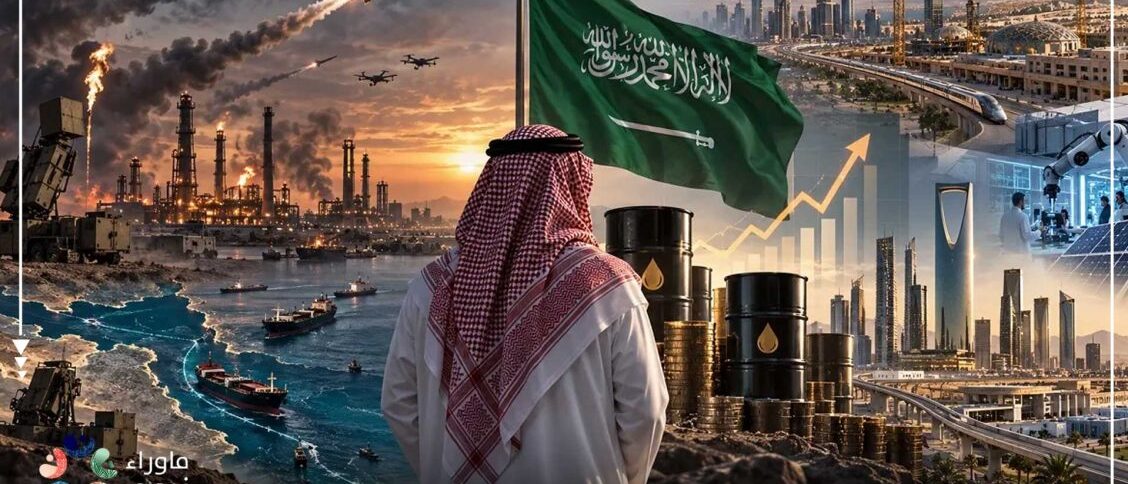
Saudi Arabia’s economic pressures can no longer be dismissed as temporary fluctuations. Indicators published between November 12 and 18, 2026, paint a troubling picture: a contracting economy, oil prices falling below $92 a barrel, the Kingdom’s flagship investment conference postponed for an entire year, and NEOM projects undergoing reassessment under the pressures of war.
Meanwhile, a Saudi company has announced that it is exploring potential investments worth between $25 billion and $30 billion in Pakistan.
The contradiction is striking. Saudi Arabia, which presented Vision 2030 as a transformative strategy to reduce dependence on oil, now finds itself compelled to prioritize protecting its petroleum infrastructure, reassessing its ambitious urban development projects, and securing additional liquidity—all while some Saudi companies pursue major investment opportunities abroad.
These are not simply short-term difficulties. They expose a widening gap between the scale of the Kingdom’s economic promises and its capacity to finance them amid war and market disruption.
Economy Contracts 3.8%: Oil Returns to the Center of the Crisis Despite Higher Production
According to a Reuters analysis published on November 16, Saudi Arabia’s gross domestic product contracted by 3.8% year-on-year in the third quarter of 2026, despite oil production recovering to approximately 10.6 million barrels per day in October.
Taken together, these figures highlight a fundamental reality: increasing oil production alone is not enough to protect the economy.
Oil revenues are determined not merely by the volume extracted from the ground, but by how much crude actually reaches international markets and the costs associated with transportation, storage, insurance, and disruptions.
During wartime, this equation becomes considerably more fragile. Additional expenses involved in delivering each barrel can absorb a substantial portion of the financial benefits generated by higher production volumes.
More importantly, the contraction comes at a time when Saudi Arabia’s non-oil sectors were expected to have developed sufficient strength to provide greater protection against shocks affecting the petroleum industry.
If disruptions to oil production and exports can still push GDP into contraction on this scale, how far has economic diversification actually progressed?
The headline GDP figure alone cannot answer that question. Nevertheless, it places the effectiveness of Vision 2030 under a demanding practical test—one that requires examining actual economic resilience rather than simply measuring expenditure on ambitious development projects.
Brent Falls Below $92: War Does Not Guarantee Higher Oil Prices
During trading on November 18, Brent crude fell to approximately $91.99 per barrel, while West Texas Intermediate declined to $84.34.
Saudi Arabia’s stock market also recorded losses.
Reuters attributed the decline in oil prices to rising US inventories and expectations of increased global supply, while Gulf financial markets remained under pressure from military risks.
War does not guarantee a sustained increase in oil prices sufficient to offset its economic costs.
Security concerns may temporarily push prices higher, but growing supply or slowing demand can drive them downward even while regional tensions persist.
Saudi Arabia therefore faces the possibility of three simultaneous pressures: lower crude prices, higher export costs, and increased expenditure on protecting energy infrastructure.
Relying on an oil market recovery to finance economic transformation has consequently become a riskier proposition than it appeared two years ago.
NEOM Under Review: Ambitious Plans Confront Economic Realities
The war, declining revenues, and rising shipping and insurance costs have reportedly prompted Saudi authorities to reconsider the scope of certain megaprojects, while assigning greater priority to protecting oil infrastructure.
Interest in data centers and artificial intelligence remains, but some ambitious urban development plans are being reassessed.
Reordering economic priorities is not inherently problematic. The real issue is how such decisions are presented and explained.
Scaling back a project previously announced with enormous ambitions requires transparency.
How much money has actually been spent? What assets and infrastructure have been completed? What costs remain outstanding? And what financial returns can realistically be expected from the revised project?
Simply describing a reduction in scope as a “reordering of priorities” is not enough.
The appropriate economic benchmark is the value generated by the capital already committed—not the scale of the promises originally made.
Investment Conference Postponed Until 2027: Security Risks Enter Investors’ Calculations
The tenth edition of the Future Investment Initiative (FII) conference has been postponed from October 2026 to October 25–28, 2027.
The FII Institute confirmed the revised dates, while Reuters reports linked the postponement to security disruptions and their impact on aviation.
The conference is far more than a ceremonial gathering.
It serves as Saudi Arabia’s flagship platform for promoting investment opportunities to leading international fund managers and major financial institutions.
Postponing it for an entire year indicates that security risks have become a significant factor in the investment environment.
Attracting international capital requires more than promotional announcements.
Investors assess flight reliability, employee safety, operational continuity, insurance costs, and the broader predictability of the business environment.
When these factors become more expensive or complicated, the consequences may first emerge through tighter financing conditions and higher returns demanded by investors.
The contradiction is difficult to ignore: How can Riyadh promote itself as a global business hub while its most prominent investment conference is postponed amid security concerns?
Stability is not a minor detail that can be compensated for through marketing campaigns.
Aramco Explores Alternative Routes as Protecting Oil Infrastructure Takes Priority
Saudi Aramco is reportedly considering expanding the capacity of its East-West Pipeline and increasing transportation and storage capabilities outside the Kingdom.
The pipeline currently has a capacity of approximately seven million barrels per day, with around four million barrels per day being transported through it to Yanbu during the disruptions.
The pipeline represents an important strategic alternative for oil exports, but it does not eliminate security risks, particularly given threats affecting energy facilities.
The economic implications are direct.
Saudi Arabia is being compelled to allocate additional resources to protecting the very industry upon which it seeks to reduce its dependence.
Every new investment in pipelines and storage infrastructure competes for capital that could otherwise be directed toward non-oil development projects.
The dilemma exposed by the war is clear: economic diversification cannot be accelerated without stable oil revenues, yet protecting those revenues consumes resources that might otherwise support diversification itself.
$30 Billion in Pakistan: A Massive Investment Proposal at a Sensitive Time
Saudi company Delta Energy has announced the signing of a memorandum of understanding with a Pakistani entity to explore energy infrastructure projects with a proposed value ranging from $25 billion to $30 billion.
The potential projects include gas pipelines, liquefied natural gas facilities, storage infrastructure, and possible routes toward the port of Gwadar.
The announced figure does not represent an investment that has already been executed or a final financing commitment.
The agreement remains at the feasibility-study stage.
Delta Energy is not the Public Investment Fund, and there is no evidence that the proposed amount has been allocated from Saudi Arabia’s government budget.
Nevertheless, the announcement raises questions about investment priorities at a time when domestic projects face significant financial pressures.
Cross-border infrastructure projects can generate strategic and commercial returns, but they also involve substantial political, regulatory, and financing risks, particularly when they depend on complex regional arrangements.
Announcing a figure as large as $30 billion does not automatically transform a proposed project into an economic achievement.
What matters is identifying the sources of financing, the guarantees involved, the expected returns, and the parties that will ultimately bear the risks.
Public Investment Fund Seeks Liquidity: Asset Wealth Does Not Mean Readily Available Cash
These developments coincide with earlier reports that Saudi Arabia’s Public Investment Fund has been examining new mechanisms to finance its portfolio companies.
The options include selling stakes in mature assets, using future cash flows to support financing instruments, and attracting additional investors.
Such measures can be commercially reasonable ways to improve capital efficiency.
However, they also raise questions about whether some portfolio companies can generate sufficient cash flows to finance their own expansion.
Selling equity stakes provides liquidity today but reduces ownership of potential future profits.
Borrowing against anticipated revenues, meanwhile, shifts financial obligations into future years.
With the economy contracting, oil prices declining, and infrastructure protection costs increasing, the priority becomes identifying projects capable of generating genuine economic returns rather than continuing to finance them primarily because of their symbolic importance or international visibility.
Financial Realities, Not Promises, Will Determine the Future
The developments of November 2026 reveal a challenge extending far beyond a temporary decline in oil prices or the postponement of an investment conference.
A 3.8% economic contraction, Brent crude falling below $92, the reassessment of NEOM, the postponement of the Future Investment Initiative, and the exploration of massive overseas investments all suggest that the war has increased the cost of implementing Vision 2030 and forced difficult economic trade-offs.
Saudi Arabia is confronting not only the question of how much capital remains available, but also how that capital should be allocated between protecting existing revenue streams, financing future development projects, and generating returns sufficient to justify outstanding financial commitments.
If Vision 2030 was launched with the promise of creating an economy less dependent on oil, the war raises an increasingly difficult question:
Has financing Saudi Arabia’s economic transformation become more dependent than ever on the security of its oil facilities and the stability of global crude prices?
The true benchmark is not the number of projects announced or the value of memoranda of understanding signed.
It is the economy’s ability to remain resilient and sustain growth when oil prices decline and security risks intensify.
Under these conditions, ambitious promises are no longer sufficient.
What is required is transparent financial data, measurable investment returns, and clear accountability for the economic costs of decisions that will shape Saudi Arabia’s future for years to come.