
From a multibillion-dollar attempt to acquire a video game technology company to the potentially costly dismantling of LIV Golf and another injection of capital into England’s Newcastle United, recent developments expose a striking contradiction in Saudi Arabia’s investment strategy.
At a time when the Kingdom is grappling with economic contraction, a widening budget deficit, and security disruptions threatening its tourism and entertainment industries, the Saudi leadership continues to channel billions of dollars into global sports. Meanwhile, some projects previously promoted as strategic achievements are beginning to face retrenchment, restructuring, or possible closure.
The central question surrounding Saudi sports investments is no longer how much Riyadh can afford to spend, but what these enormous financial commitments have actually delivered—and whether the economy can sustain such a strategy amid war and declining oil revenues.
Developments reported by *The Wall Street Journal*, *Reuters*, and *The Athletic*, alongside announcements of event cancellations inside the Kingdom, paint a deeply contradictory picture.
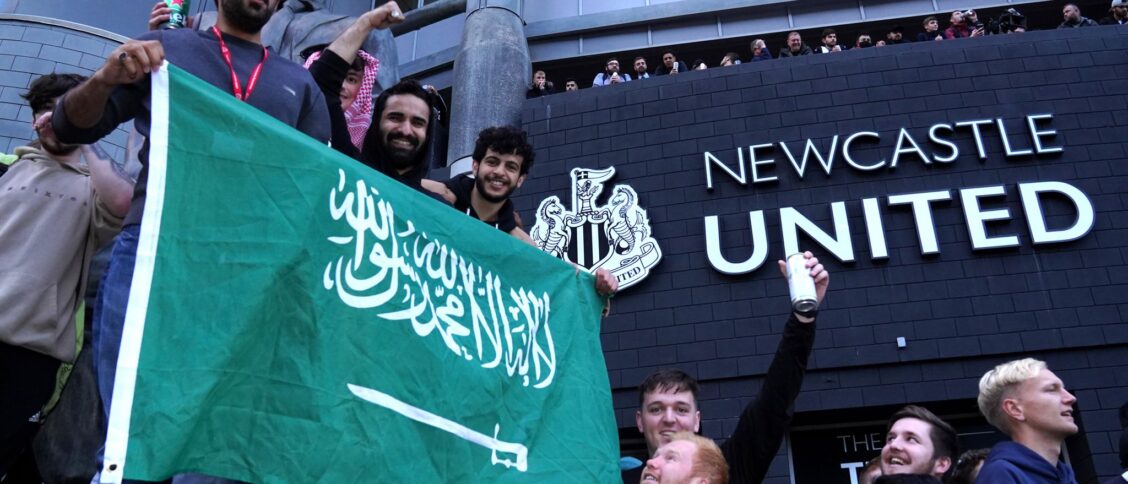
Saudi Arabia’s Public Investment Fund (PIF) is reportedly negotiating a deal to acquire Unity for approximately $25 billion, while LIV Golf is reportedly heading toward liquidation after more than $5 billion in spending. At the same time, the fund has injected another £95 million into Newcastle United to cover losses.
Domestically, entertainment and sporting events are being cancelled amid security concerns, while economic activity contracts and the budget deficit widens.
The contrast raises fundamental questions about Saudi Arabia’s spending priorities: billions are being committed to building international influence through sports and entertainment, even as the costs of maintaining economic stability and supporting domestic tourism and entertainment activities continue to rise.
Saudi Arabia’s Sports Spending Bill: Billions Committed, Returns Still in Question
To understand the scale of Saudi Arabia’s financial commitments, the figures must be examined collectively, while distinguishing between money already spent and transactions that remain under negotiation.
| Project | Reported Amount | Nature of Financial Commitment |
|—|—|—|
| Potential acquisition of Unity | $25 billion | Proposed transaction under negotiation |
| LIV Golf | More than $5 billion | Previous spending, according to the cited report |
| Newcastle United | £95 million | Additional funding to cover losses |
| LIV Golf in Saudi riyals | Approximately SAR 18.75 billion | Estimated equivalent of previous spending |
| Newcastle United in US dollars | Approximately $125 million | Estimated equivalent, subject to exchange-rate fluctuations |
Combined, the reported spending on LIV Golf and the additional financing provided to Newcastle United exceed approximately $5.1 billion. Including the potential Unity acquisition brings the total value associated with these developments to more than $30 billion.
However, this figure does not represent realized losses, nor does it consist entirely of new expenditure. It combines previous investments, a transaction that has yet to be finalized, and additional financing.
Nevertheless, the figures illustrate the extraordinary scale of the financial commitments being made by the Public Investment Fund across sports, entertainment, and related technology industries.
The fundamental question is not whether Riyadh can write multibillion-dollar checks, but whether these investments can generate economic returns sufficient to justify their costs.
Acquiring international assets may deliver future profits, but the true value of any investment is determined by its returns, risks, and opportunity costs—not by the size of the headline transaction.
Assessing the results is therefore an economic necessity rather than an optional accounting exercise.
LIV Golf: More Than $5 Billion Spent on Sporting Influence, With Liquidation Reportedly Looming
LIV Golf represents perhaps the most controversial development among Saudi Arabia’s recent sporting investments.
According to information attributed to *The Wall Street Journal* in the referenced material, the Saudi-backed golf league is reportedly moving toward liquidation after the Public Investment Fund spent more than $5 billion on the project.
LIV Golf was launched as an ambitious attempt to reshape professional golf and challenge the traditional institutions that have long dominated the sport.
Its strategy relied heavily on attracting prominent players through lucrative contracts and substantial prize money, reflecting Saudi Arabia’s broader ambition to use international sports as a vehicle for expanding its global presence.
However, should the venture ultimately be liquidated, its collapse would raise serious questions about the investment decisions behind its creation.
How can spending exceeding $5 billion be justified on a project that may cease operations without achieving the commercial sustainability upon which its ambitions were built?
The reported expenditure does not necessarily mean that the entire amount constitutes an irreversible loss. Assets, commercial rights, or financial settlements may retain recoverable value.
Yet that possibility does not eliminate the need for a transparent financial accounting of the project.
What is required is not merely an announcement marking the end of the venture, but a detailed explanation of the revenues generated, accumulated operating losses, outstanding liabilities, and the value that could potentially be recovered.
The project also raises questions about how sports investment decisions are made within the PIF.
Were those decisions grounded in realistic commercial feasibility studies? Or did the pursuit of rapid international visibility encourage an unusually high tolerance for financial risk and expenditure?
Media influence purchased through enormous financial commitments may prove temporary, while the losses associated with commercially unsustainable ventures can remain on investors’ balance sheets for years.
If Riyadh intends to build a diversified economy through sports, one essential measure of success is whether these ventures become profitable businesses rather than platforms dependent on continuous financial support.
Newcastle United: Another £95 Million for a Club Still Requiring Financial Support
In a separate development, *The Athletic* reported that the Public Investment Fund injected £95 million into Newcastle United within a single week to cover losses.
The report renews questions about the economic rationale behind Saudi Arabia’s acquisitions in international football.
Purchasing a major European football club involves considerably more than the initial acquisition price. It also requires continued investment in infrastructure, player transfers, wages, and operating expenses.
Although a club’s valuation may increase over time, that potential appreciation does not eliminate the financial risks borne by investors during its development.
When a football club owned by a sovereign wealth fund requires tens of millions of pounds in additional financing to cover losses, the discussion surrounding sports investment must move beyond celebrating ownership toward examining financial performance.
The £95 million injection is equivalent to approximately $125 million, based on an indicative exchange-rate conversion, or roughly SAR 469 million.
On its own, this amount does not constitute a decisive financial burden for a sovereign wealth fund of the PIF’s size. It does, however, illustrate the recurring financial obligations that can accompany ownership of professional sports clubs.
If sporting investments require continued capital injections, their success cannot be measured solely through trophies, competitive achievements, or international media exposure.
It must also be assessed through commercial revenue growth, asset appreciation, and the ability to reduce operating losses.
Additional financing does not automatically mean that Newcastle United is an unsuccessful investment. Nevertheless, it calls for a clear explanation of how the anticipated financial returns are expected to materialize.
The central question remains: Are these investments being managed primarily according to commercial profitability, or do considerations surrounding international image continue to justify expenditure even when financial results fall short of expectations?
$25 Billion for Unity: Does Saudi Arabia Need Another Acquisition of This Magnitude?
Against this backdrop, *Reuters* reported that the Public Investment Fund was in negotiations to acquire Unity in a transaction valued at approximately $25 billion.
Unity operates in the software and technology sector, providing tools used to develop video games and interactive applications. This positions the company within the broader digital technology and entertainment industries.
In principle, investment in this sector can be viewed as part of Saudi Arabia’s economic diversification strategy.
However, the size and timing of the proposed acquisition raise significant questions.
The $25 billion valuation is equivalent to approximately SAR 93.75 billion—an amount exceeding Saudi Arabia’s reported third-quarter 2026 budget deficit of approximately SAR 84 billion.
This comparison does not suggest that funds allocated to an acquisition could automatically be redirected to the government budget. The PIF and the state budget operate under different financial structures, and acquiring a company involves obtaining an asset in exchange for capital.
Nevertheless, the comparison highlights the extraordinary size of the proposed transaction at a time when public finances are under substantial pressure.
While the government attempts to manage a widening gap between revenues and expenditures, its sovereign wealth fund is considering an acquisition worth tens of billions of dollars.
The issues requiring scrutiny include how the transaction would be financed, its expected financial returns, and the extent to which it would contribute directly to domestic economic development.
Would the acquisition facilitate the transfer of knowledge and technology to Saudi Arabia? Would it generate employment opportunities and new projects within the Kingdom? Or would it remain primarily an overseas investment whose success depends on the performance of an international company and fluctuations in global technology markets?
These questions do not rule out the possibility of substantial profits from the acquisition.
They do, however, challenge the assumption that every major transaction should automatically be celebrated as an economic achievement simply because of its scale.
Owning a global company does not necessarily translate into building a domestic industry, just as purchasing technology does not guarantee its successful integration into the Saudi economy.
The ultimate test will lie in measurable results, not the transaction’s headline valuation.
Domestic Event Cancellations: When the Entertainment Industry Confronts Security Risks
While billions of dollars continue to flow into international sports and entertainment, another report points to the cancellation of six events at The Warehouse, a venue that had previously hosted a performance by the Saudi band Hajeem.
The information appeared in an image attributed to an official statement, although the available material did not provide sufficient details to establish the reasons behind the cancellations or estimate their financial impact.
Nevertheless, the development assumes broader significance against the backdrop of security disruptions reportedly experienced by the Kingdom in recent weeks.
The entertainment industry depends heavily on organizers’ ability to deliver scheduled events and on confidence among audiences, sponsors, and businesses in the stability of the operating environment.
Repeated disruptions can affect ticket sales, sponsorship agreements, commercial contracts, and investor confidence.
The cancellation of six events cannot, by itself, be treated as evidence of a collapse in Saudi Arabia’s entertainment industry. Nor can the war be conclusively identified as the direct cause without an official explanation.
However, the development raises a broader question about the sector’s ability to maintain growth amid heightened security risks.
An entertainment industry that depends on stability to attract audiences cannot be protected by financial expenditure alone, regardless of how much is invested in festivals, venues, and major events.
The contradiction becomes more apparent when domestic cancellations are considered alongside massive overseas investments.
While negotiations are reportedly underway to acquire an international company for $25 billion, some entertainment activities inside the Kingdom are facing disruptions that affect their continuity.
This underscores the importance of aligning investment priorities with domestic economic needs and the capacity of the local economy to benefit directly from the capital being deployed.
War Raises the Cost of Saudi Ambitions as the Economy Contracts and the Budget Deficit Widens
These developments cannot be separated from Saudi Arabia’s broader economic situation during the war.
Preliminary figures indicated that real gross domestic product contracted by 3.8% year-on-year in the third quarter of 2026, accompanied by a sharp decline in oil-related economic activity.
Meanwhile, the budget deficit widened to approximately SAR 84 billion during the same quarter, according to figures reported by *Bloomberg*, amid a significant decline in oil revenues.
Earlier reports also indicated that the Public Investment Fund was seeking a $3 billion loan backed by an Italian guarantee as part of efforts to secure additional financing.
Together, these indicators place Saudi Arabia’s sports investments under a different level of economic scrutiny.
During periods of strong growth and elevated revenues, governments may enjoy greater flexibility in financing projects with long-term investment horizons.
However, when the economy is contracting and revenues are weakening, opportunity costs become increasingly important.
Every billion dollars allocated to an overseas project represents an investment decision that should be assessed against alternative opportunities capable of generating higher returns or more immediate economic benefits within the Kingdom.
This does not mean that overseas investments are inherently unproductive or that all funds directed toward sports should instead have been allocated to the government budget.
Yet insufficient disclosure of investment returns and losses makes it difficult to determine whether these commitments remain consistent with national economic priorities during a period of crisis.
The issue becomes even more significant when sporting investments serve strategic objectives extending beyond direct financial returns, including strengthening Saudi Arabia’s international image and expanding its economic influence.
If such objectives form part of the rationale for these investments, their costs and outcomes should be clearly identified and evaluated.
International prestige is not a substitute for financial sustainability, and media visibility cannot compensate for the absence of economic returns.
From LIV Golf to Unity: Are Saudi Sports Investments Becoming Open-Ended Financial Commitments?
Recent developments reveal a deeper challenge in the management of Saudi Arabia’s investment portfolio.
The Public Investment Fund is not merely entering new ventures; it is also assuming continuing financial obligations associated with existing investments.
At the same time, some projects may face restructuring or closure if they fail to achieve their intended objectives.
Such developments are not unusual in the investment world. However, they become particularly sensitive when they involve a sovereign wealth fund playing a central role in implementing a national economic transformation strategy.
The fund’s success should not be measured solely by the value of its assets or the number of companies in which it holds stakes.
It should also be judged by its ability to generate sustainable returns and manage investment risks effectively.
In this context, the reported possibility of liquidating LIV Golf would test the PIF’s willingness to recognize underperforming ventures and reallocate capital.
Similarly, the additional financing provided to Newcastle United raises questions about whether the club can eventually achieve a more financially sustainable business model.
The potential Unity acquisition, meanwhile, raises questions about the continued pursuit of enormous new investments before the final results of some earlier commitments have become clear.
If the investment strategy involves continually moving from one multibillion-dollar venture to an even larger one, the principal risk may not lie in the scale of the ambition itself, but in the possibility that financial obligations accumulate faster than investment returns.
Detailed disclosure of the financial performance of sports investments is therefore essential, including capital committed, revenues generated, operating losses, and current asset valuations.
Economic accountability does not undermine investment ambition. Rather, it helps prevent that ambition from becoming a succession of costly decisions whose outcomes are difficult to evaluate.
Billions for Sporting Influence: Who Bears the Cost of Saudi Arabia’s Economic Choices?
Taken together, the five reported developments place Saudi Arabia’s investment policy under intense scrutiny.
LIV Golf, which has reportedly consumed more than $5 billion, is said to be moving toward liquidation. Newcastle United has required an additional £95 million to cover losses. Meanwhile, the Public Investment Fund is reportedly negotiating a potential $25 billion acquisition of Unity.
At home, entertainment events are being cancelled while public finances face a substantial deficit and the economy experiences contraction associated with declining oil activity and the repercussions of war.
These developments do not mean that all Saudi sports investments are losing money, nor do they establish that every dollar committed has been wasted.
They do, however, highlight the urgent need to reassess spending priorities and measure actual investment returns.
A country facing mounting economic and security pressures cannot rely solely on demonstrating its ability to purchase football clubs, acquire global companies, and launch international sporting competitions.
It must also demonstrate that such investments generate economic value proportionate to the resources they consume.
The most pressing issue concerns the distinction between commercially driven investment and expenditure intended to secure international influence and enhance the country’s global image.
If certain ventures are designed to deliver political or reputational benefits, those objectives should not obscure their financial costs or weaken standards of accountability.
Amid war, economic contraction, and a widening fiscal deficit, the contradiction becomes increasingly pronounced: billions are being committed to acquiring international assets while pressure mounts on the domestic sectors expected to drive economic diversification.
Will these conditions prompt the Public Investment Fund to reassess its commitments to sports and entertainment? Or will it continue pursuing increasingly large transactions despite delayed returns and rising financial obligations?
And can the Saudi leadership demonstrate that its sports spending contributes to building a productive economy rather than becoming an extraordinarily expensive means of expanding its international presence?
Ultimately, the true measure of success for Saudi Vision 2030 is not the number of football clubs Saudi Arabia owns or the value of the companies it can afford to acquire.
It is the economy’s ability to generate sustainable wealth and maintain stability without requiring ever-increasing financial injections into ventures whose economic viability remains uncertain.
.