

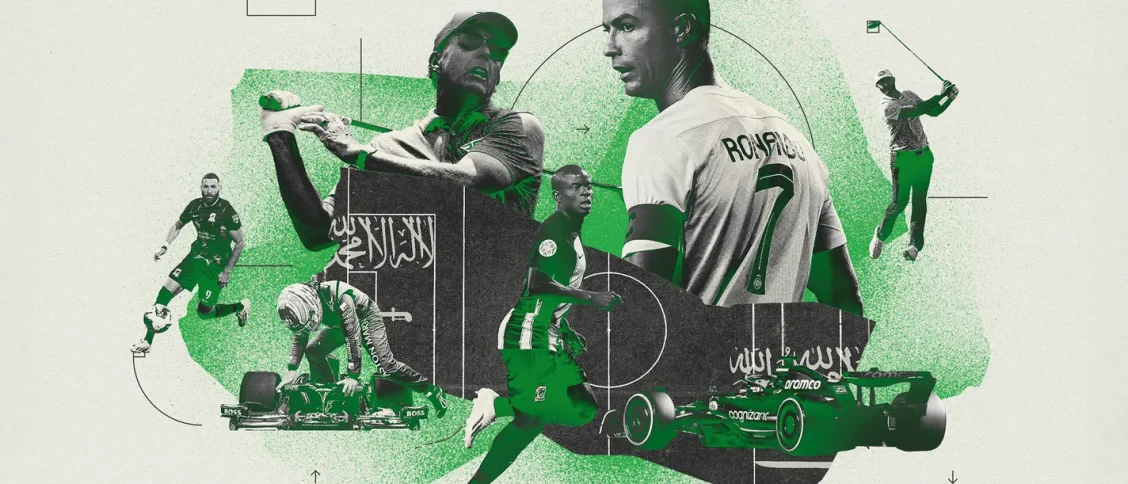
The episode involving Turki Al‑Sheikh and Canelo Álvarez cannot be treated as a harmless anecdote or a fleeting display of personal warmth. It is a compressed illustration of how public money is administered in Saudi Arabia under the banners of entertainment and sportswashing, where vast sums are mobilized through personalized authority rather than public policy. A deal valued at roughly four hundred million dollars, theatrically paired with a gift of used fight clothing, was staged for public consumption as a sentimental exchange. The imbalance is not symbolic trivia; it exposes a governing logic in which value, accountability, and institutional restraint are subordinated to spectacle and personal gratification.
Four hundred million dollars is not an abstract figure in a political economy facing mounting fiscal pressures, record borrowing, and the quiet postponement or downsizing of projects once marketed as pillars of “Vision 2030.” Yet the transaction was framed not through measurable public return but through narratives of gratitude, loyalty, and an expressed desire to extend a star’s presence for several years, as though the treasury were a participant in a private relationship. When fiscal decisions are justified by emotion and mood, public spending ceases to function as policy and becomes a personalized performance, detached from cost–benefit scrutiny or institutional oversight.
The public celebration of the “gift” sharpened this distortion. Clothing worn in previous bouts was elevated into a legitimizing symbol for an expenditure of extraordinary scale. The issue is not the existence of a gift but its instrumentalization as proof of reciprocity, implying that symbolic tokens can compensate for asymmetrical exchanges of power and money. In a state that has shifted the burdens of “financial reform” onto its citizens, this scene operates as provocation: austerity rhetoric for the many, discretionary excess for elite entertainment projects. The implicit message is that standards are suspended when celebrity and spectacle are involved.
Sportswashing, by its own internal logic, presumes a calculable return: reputational rehabilitation, durable sporting infrastructure, and a domestic ecosystem that extends beyond imported stars. What emerges instead is a pattern of inflated contracts and performative moments, with little transparent discussion of long-term utility or the development of local sport. When a star interrupts an official to dismiss any attempt at justification—reducing the exchange to “forget the talk”—the relationship is laid bare as an unequal trade: money for presence, presence for applause. The public is relegated to spectatorship, excluded from inquiry and stripped of any mechanism to question how or why such sums are committed.
This is therefore not a story about a boxer or a keepsake. It is about a governing model that treats public funds as instruments for manufacturing sentiment rather than implementing accountable policy, privileging symbols over outcomes and immediacy over sustainability. Four hundred million dollars exchanged for used apparel is not dark humor; it is a marker of a political moment in which prestige overrides calculation, curated happiness displaces public interest, and the camera frame substitutes for institutional responsibility. In an era of tightening resources and expanding obligations, the unresolved question is not one of optics but of power: who is accountable when public money is reduced to a souvenir?