
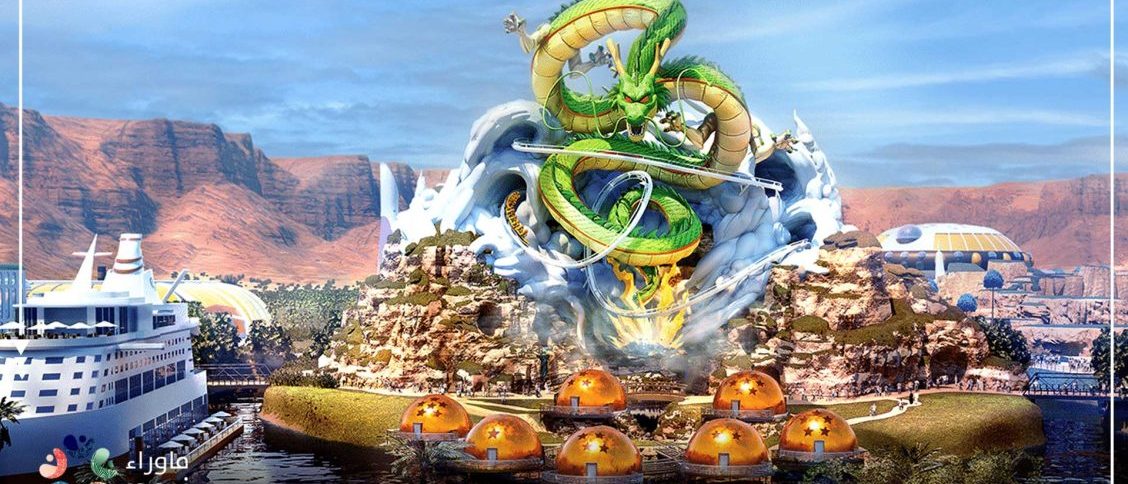
A reported €6 billion Saudi investment could create 22,000 jobs in France. Behind the headline — and the story of Mohammed bin Salman and Emmanuel Macron’s shared enthusiasm for Dragon Ball Z — lies a more serious question about how Saudi sovereign wealth is being allocated.
At a time when Saudi Arabia is reassessing spending priorities, demanding higher returns from its megaprojects and searching for ways to create more high-quality jobs at home, one proposed investment deserves particularly close scrutiny.
A Saudi-backed plan reportedly worth around €6 billion — approximately SAR 26 billion — would develop three major theme parks outside Paris, including a manga-themed destination. According to accounts surrounding the project, its origins can be traced partly to a conversation between Saudi Crown Prince Mohammed bin Salman and French President Emmanuel Macron, during which the two discovered a shared enthusiasm for manga, particularly Dragon Ball Z.
As diplomatic anecdotes go, it is harmless enough. As the origin story for a multibillion-euro investment involving a company owned by Saudi Arabia’s Public Investment Fund, it raises rather more consequential questions.
Personal interests are one thing. Sovereign capital is another.
Once billions in state-backed investment enter the equation, the relevant questions are no longer about what two leaders enjoy watching. They are about expected returns, opportunity costs, investment governance and why this particular project deserves such a large allocation of Saudi capital.
SAR 26 billion is not a ticket to a theme park
Six billion euros is an enormous investment by almost any measure.
The three developments are reportedly planned roughly 30 kilometres from Paris and are expected to create around 22,000 direct jobs.
For France, the attraction is obvious. Billions in foreign capital would support construction, tourism, property development, suppliers and commercial activity, while creating thousands of jobs and potentially generating substantial tax revenues.
From the French perspective, there is little mystery as to why the project would be welcomed enthusiastically.
The more interesting question is why Saudi sovereign capital should finance it — and what Saudi Arabia expects to receive in return.
Foreign investment is not charity. If the developments generate strong profits, those returns could ultimately benefit the Saudi investor. But an investment of this scale cannot be assessed simply by pointing to its size or international profile.
Saudi Arabia must be able to explain why this use of SAR 26 billion offers a better risk-adjusted return than the alternatives competing for the same capital.
22,000 jobs — but in France
The projected employment figure is perhaps the project’s most politically striking number.
Around 22,000 direct jobs could be created.
They would, however, be created in France.
That does not automatically make the investment bad for Saudi Arabia. Sovereign wealth funds invest abroad precisely because geographical diversification can protect and grow national wealth. A profitable French asset may ultimately serve Saudi interests better than an unproductive domestic project.
But the investor here is not simply a private pension fund pursuing returns in isolation. The PIF has been given a central role in Vision 2030, including developing new industries, diversifying the Saudi economy and supporting employment and investment inside the kingdom.
That makes the opportunity cost impossible to ignore.
If SAR 26 billion can help generate 22,000 direct jobs around Paris, what could the same capital produce if deployed in productive industries inside Saudi Arabia?
The answer may still favour France. But at this scale, it deserves to be demonstrated rather than assumed.
The Qiddiya paradox
There is an additional irony: the project is being pursued by Qiddiya Investment Company.
Qiddiya was conceived around a straightforward domestic proposition. Saudi Arabia would develop its own world-class entertainment, sports and cultural infrastructure, capturing spending that Saudis had historically taken abroad and building new industries at home.
In simplified terms, the argument was: instead of Saudis travelling elsewhere for entertainment, build destinations compelling enough to keep that expenditure in the kingdom.
Now the company created to advance that strategy is looking towards France to develop entertainment destinations there.
There may be a perfectly rational commercial case. Qiddiya could be attempting to become an international entertainment group rather than remain a domestic developer. European expansion could diversify revenue, build operating expertise and establish a global brand whose value eventually benefits Saudi Arabia.
But those claims require numbers.
What return is expected? What proportion of the capital will Saudi Arabia provide? When is the investment expected to break even? Why France? And why is building new entertainment assets outside Paris more attractive than expanding productive assets at home or purchasing established international businesses with proven cash flows?
Calling a strategy “global” does not, by itself, make it profitable.
Then Dragon Ball Z enters the investment story
The most unusual detail is the account of how the idea emerged.
The project has reportedly been linked to a December 2024 conversation in Riyadh between Macron and Mohammed bin Salman, during which their shared interest in manga — particularly Dragon Ball Z — came up.
It may be nothing more than an appealing diplomatic anecdote used to humanise and market a much more conventional investment process.
If so, the actual investment case should be straightforward to demonstrate.
But if the personal conversation materially contributed to the creation of a €6 billion sovereign-backed investment, a legitimate governance question follows: how much influence should the personal enthusiasm of political leaders have over the allocation of public wealth?
A project of this magnitude should ultimately rest on market research, projected demand, financing structures, expected returns, downside scenarios and independent investment scrutiny.
Not personal enthusiasm, however genuine.
A leader’s hobby and a sovereign portfolio are different things
The distinction matters because sovereign investment requires a higher standard of governance than private spending.
A private entrepreneur can decide to spend personal wealth building an entire Dragon Ball theme park because they love the franchise. If the project succeeds, they reap the rewards. If it fails, their capital bears the loss.
Sovereign capital is different.
Political leaders are entitled to personal interests. Those interests should not substitute for investment committees, independent analysis and clearly defined financial objectives.
The more centralised the decision-making structure, the more important it becomes to demonstrate that a multibillion-dollar investment survived rigorous commercial assessment independent of the preferences of those at the top.
France is getting many of the things Saudi Arabia wants for itself
There is a sharper economic irony in the proposed deal.
Saudi Arabia has spent years attempting to attract foreign capital, create jobs, expand tourism, develop an entertainment industry and bring international visitors into the kingdom.
This project could deliver several of those benefits — to France.
France gets Saudi foreign direct investment. It gets thousands of potential jobs. It gets construction activity, new tourism infrastructure and additional visitor spending.
Saudi Arabia, meanwhile, is taking its capital abroad to provide some of the very economic benefits it has spent years asking foreign investors to bring to Riyadh.
Again, that is not inherently irrational. Successful countries routinely invest abroad while simultaneously attracting foreign investment.
But the project needs to produce sufficiently strong returns to justify the apparent contradiction.
Saudi Arabia should invest abroad — but that makes transparency more important
Criticism of the project should not collapse into the simplistic argument that Saudi money must remain inside Saudi Arabia.
That would be poor portfolio management.
Geographic diversification is valuable. International assets can provide income streams uncorrelated with the domestic economy. A highly profitable French entertainment business could be a better investment than another weak project inside the kingdom.
But that argument strengthens, rather than weakens, the case for transparency around the investment thesis.
The justification should be that the project offers Saudi Arabia an attractive commercial return, strategic expertise or another clearly defined benefit.
It should not be that two leaders happen to like the same manga franchise.
The PIF no longer operates in a world of unlimited capital
Timing makes the issue particularly significant.
Saudi capital is already being stretched across Neom, Qiddiya itself, Red Sea tourism, Diriyah, Lucid, gaming, artificial intelligence, mining, sport, aviation and infrastructure. Many of those commitments require billions more before reaching maturity.
In that environment, SAR 26 billion is not spare change.
Capital allocation means choosing one opportunity over another. Every riyal committed to France is a riyal that must outperform whatever Saudi Arabia could have done with it elsewhere.
The French theme-park investment therefore needs to win that competition on its merits.
The relevant question is not whether the PIF can afford €6 billion. It is whether this is one of the best uses available for €6 billion.
Macron knows what France is getting
From the French side, the calculation appears much simpler.
France wants investment. It wants employment, major developments and additional tourism infrastructure.
The reported response from Macron’s office to questions about accepting Saudi investment despite criticism of the kingdom’s human-rights record was strikingly pragmatic: when France is attracting a project, it is not in the business of lecturing the investor.
The economic translation is uncomplicated: the capital is welcome.
That illustrates another dimension of Saudi overseas investment. Money does not merely purchase financial assets. At sufficient scale, it creates constituencies and interests.
A country responsible for billions in investment and thousands of jobs inevitably acquires greater weight in the political calculations of the recipient state.
Twenty-two thousand jobs can speak louder than political speeches
That makes the project relevant beyond entertainment economics.
French journalists’ unions and rights advocates may continue raising questions about Jamal Khashoggi, freedom of expression and Saudi Arabia’s human-rights record. At the same time, a French government presented with billions in investment and thousands of potential jobs has powerful incentives to maintain close economic relations with Riyadh.
This is where sovereign investment can double as soft power.
An overseas project can generate returns while simultaneously creating economic stakeholders whose interests become tied to the investor.
The theme parks would therefore represent more than rides, hotels and manga attractions. They could become another strand in an expanding network of Saudi-French economic interests.
Is Saudi Arabia buying profits, influence — or both?
That distinction should be made explicit.
If this is primarily a commercial investment, its commercial case should withstand scrutiny.
If Qiddiya wants to become an international entertainment brand, the strategy and expected benefits should be explained.
If part of the value is geopolitical — deepening relations with France and creating economic interests tied to Saudi Arabia — that too can be evaluated as a strategic objective.
The problem comes when the objectives blur.
Without clarity, political benefits can always be invoked to excuse weak financial performance, while projected commercial returns can be used to avoid discussing the political purpose of an investment.
A sovereign wealth fund should know precisely what it is buying.
From Neom to Paris, size is still not a business model
The proposed French investment also resembles a broader feature of the Vision 2030 era: projects built around extraordinary scale, global names and narratives designed to command attention.
But years of megaproject spending have demonstrated something more mundane.
Scale is not a business model.
Neom can be architecturally extraordinary and still need to prove its economics. Lucid can build technically impressive cars and still lose billions. Saudi football can sign the world’s biggest players without automatically generating revenues sufficient to justify the expenditure.
The same applies in France.
Saudi Arabia could build Europe’s most spectacular manga destination. That does not make it a successful sovereign investment until the financial performance says so.
What exactly does SAR 26 billion buy Saudi Arabia?
That is the question that should survive long after the announcements and diplomatic photographs disappear.
The issue is not whether Mohammed bin Salman likes Dragon Ball Z. Personal taste is economically irrelevant.
Nor is the issue whether France benefits. If the projects proceed as planned, France has obvious reasons to welcome them.
The relevant question is what Saudi Arabia receives for approximately SAR 26 billion.
Profits? A global entertainment brand? Operating expertise that can be transferred back to the kingdom? Political influence? Or some combination of all four?
And what return would make this investment superior to deploying the same capital inside Saudi Arabia or buying an established global asset with a proven earnings history?
Those are the questions separating sovereign investment from a sovereign wish list.
The French side could emerge with three major entertainment developments, billions of euros in Saudi investment and an estimated 22,000 direct jobs.
Saudi Arabia must demonstrate that what it receives in exchange is more than a large bill and a warmer relationship with Paris.
Dragon Ball Z may make for a charming story about a shared childhood passion.
But once SAR 26 billion enters the story, childhood ends.
The accounting begins.