
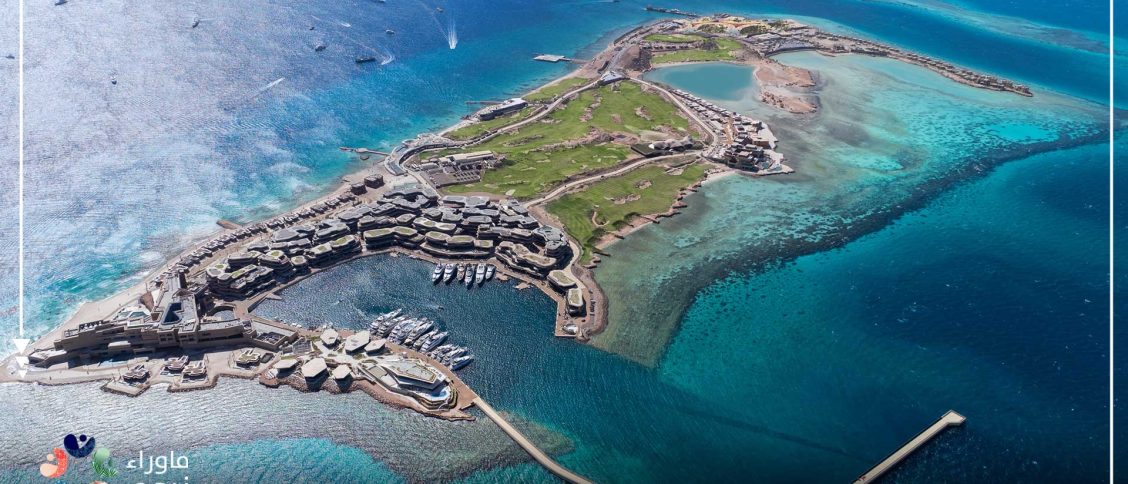
When Saudi Arabia opened Sindalah in 2024, the island was presented as the first major project to emerge from NEOM and as proof that the kingdom’s futuristic plans were finally becoming reality.
The launch was heavily promoted. Saudi officials presented Sindalah as a new luxury tourism destination on the Red Sea and as the first visible success of a project that had previously existed mainly through renderings, announcements, and ambitious promises.
Less than two years later, however, recent satellite imagery is raising new questions about what has happened since the opening.
Images published through the SoarAtlas platform compare the island in 2024 with its condition in 2026. They appear to show that parts of the project have seen little visible progress, while some areas appear less active than they did around the time of the launch.
The images do not by themselves prove that Sindalah has failed. But they add to growing concerns about whether the project has developed in the way Saudi authorities originally promised.
A High-Profile Opening Followed by Questions
Saudi Arabia spent heavily on Sindalah’s launch and invited international guests and celebrities in an effort to present the island as NEOM’s first major success story.
The message was clear: NEOM was no longer just a futuristic idea. It had begun to deliver.
But once the opening ceremony was over, international reporting began to describe a more complicated situation.
Previous reports raised questions about finishing work, the readiness of some facilities, technical and operational problems, and management changes inside NEOM itself. One of the most significant developments was the departure of the project’s former chief executive.
The latest satellite images now add a visual element to those concerns.
Rather than showing the rapid expansion that many would expect from a newly opened flagship development, the island appears to have experienced limited visible change in some areas.
When Satellite Images Challenge the Marketing
Large development projects can no longer be judged only through official statements, promotional videos, or carefully selected photographs.
Commercial satellite imagery now allows the public, journalists, investors, and researchers to track construction progress independently and compare what is happening on the ground over time.
That is what makes the Sindalah images important.
They provide another way of assessing whether the physical development of the island matches the image presented by Saudi authorities.
Again, satellite images alone cannot determine whether the entire project is commercially or operationally successful. But when they appear to show limited progress after such an ambitious launch, they inevitably raise questions about the gap between promotion and reality.
Sindalah Was Supposed to Prove NEOM Could Deliver
Sindalah was never presented as an ordinary luxury island. It carried much greater political and economic significance. As the first project officially opened under the NEOM umbrella, Sindalah was supposed to demonstrate that Saudi Arabia could turn its futuristic concepts into functioning developments.
That made the island an early test of NEOM itself. If Sindalah succeeded, Saudi authorities could point to it as evidence that larger projects such as The Line, Oxagon, and Trojena were also achievable.
But the problems reported around the island have produced the opposite effect.
Instead of becoming clear proof that NEOM can deliver, Sindalah has become another source of questions about timelines, execution, management, and long-term viability.
And if one of NEOM’s smaller and more advanced projects has struggled after opening, doubts naturally grow around the far larger and more technically complex developments still under construction.
The Image Saudi Arabia Cannot Easily Control
The comparison between 2024 and 2026 is significant because it challenges the idea that Sindalah has entered a period of rapid growth after its opening.
Major tourism projects are not judged by launch ceremonies alone. Their success depends on continued operations, visitor numbers, investment, commercial activity, maintenance, and gradual expansion.
If the physical development of the site appears stagnant—or less active than expected—then the opening itself begins to look less like the beginning of success and more like a carefully managed moment of publicity.
This is precisely the problem facing Saudi Arabia’s mega-project strategy.
The government has become highly effective at announcing projects, producing spectacular visual campaigns, and staging international launches. But the real test comes afterward, when the project must operate without the protection of promotional imagery.
The Real Test Begins After the Ribbon-Cutting
Sindalah illustrates a larger problem facing NEOM and Vision 2030.
Opening a project is easy to publicize. Keeping it commercially active, operationally stable, and financially sustainable is far more difficult. A launch event can be organized in a single day. A successful destination must prove itself over years.
That is why the latest satellite imagery matters. It raises a question that extends far beyond one luxury island in the Red Sea.
Can Saudi Arabia’s mega-projects move successfully from promotional spectacle to sustained delivery?
Or will the gap between what is promised and what actually exists on the ground continue to grow?
Sindalah was supposed to be the first clear proof that NEOM could turn imagination into reality.
Instead, it is increasingly becoming a test of whether the reality can survive once the marketing ends.