
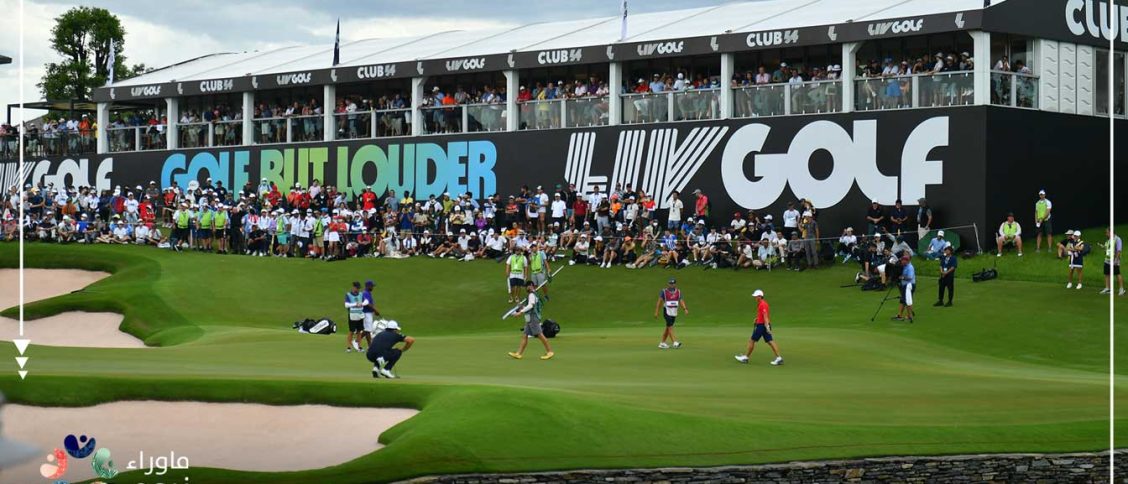
While the Saudi regime enforces strict moral codes and censorship inside the country, Crown Prince Mohammed bin Salman continues to exploit sports as a double-edged tool: buying international legitimacy on one hand, and rebranding his repressive rule on the other.
The latest manifestation of this paradox was exposed by The New York Times: the Saudi-funded LIV Golf tournament—marketed as a world-class sports initiative—has effectively become an all-day party where golf blends seamlessly with alcohol, loud music, and Western-style excess. Behind the marketing lies a clear strategy to normalize alcohol consumption in international Saudi-branded events while suppressing it entirely at home.
LIV Golf: A Nightclub Disguised as a Sports Event
According to the U.S. report, LIV Golf resembles more a music festival than a sporting event:
- Loud DJ booths blasting nightclub music
- Wine and beer stalls across the venues
- Machines specifically designed to dispense alcohol
- Strict systems that regulate the sale and consumption of drinks tailored to each host country’s audience
What was supposed to be a tournament has become a Western-style entertainment fair—with Saudi billions paying the bill.
Alcohol Policy: A Mirror of State Hypocrisy
Despite ongoing rhetoric about “red lines” and “cultural sensitivities,” LIV Golf operates under a fully developed alcohol policy that includes:
- A two-drink limit per ticket holder
- Bans on bringing in outside alcohol
- Entry refusal to visibly intoxicated guests
- No sales to underage attendees
This isn’t just logistics—it’s a clear admission that the Saudi regime is willing to override its own taboos for the sake of international image. Alcohol is prohibited at home, yet strategically commercialized abroad under the Saudi name.
Moral and Political Double Standards
The LIV Golf tournament is funded directly by the Saudi Public Investment Fund (PIF), often presented as the engine of “Vision 2030.” Yet it bankrolls events that promote values entirely at odds with the country’s internal laws and societal norms.
The glaring question remains:
If alcohol is banned and denounced in Saudi Arabia, why is it promoted and monetized at Saudi-sponsored events abroad?
The answer is simple: the regime has no guiding principles—only interests. Sports investment is not about developing sports or promoting national pride, but about image laundering and diplomatic gain at any cost.
Where Do the Profits Go?
While billions are being poured into LIV Golf, the Saudi economy is showing cracks:
- Cost of living continues to climb
- Youth unemployment remains high
- Industrial growth is stagnant
- Foreign labor dependency is growing
- Housing projects are falling behind
All this while the Public Investment Fund—meant to secure the future of the Saudi people—is used to host beer-fueled golf tournaments in the West.
A Gradual Cultural Shift… Funded by the Regime
LIV Golf is more than entertainment. It’s a calculated effort to normalize Western consumerist culture—centered around moral deregulation and spectacle—using the Saudi brand as its carrier.
What’s most dangerous is that this normalization is being driven by an official state project, financed with public funds, branded with national symbols, and marketed as economic renaissance.
This is not sports. This is propaganda, designed to reintroduce Saudi Arabia as an open market for Western values in exchange for geopolitical support—from the killing of Jamal Khashoggi to the war on Yemen.
Booze on the Green, Debt at Home
LIV Golf is just another tool in the Saudi regime’s effort to sell itself to the world while maintaining repression at home. It’s not exporting sports—it’s exporting a lie. And that lie is built on glamorizing alcohol, spectacle, and Western consumer culture, all while Saudi citizens endure censorship, debt, and economic strain.
LIV is not golf. It’s soft-power warfare.