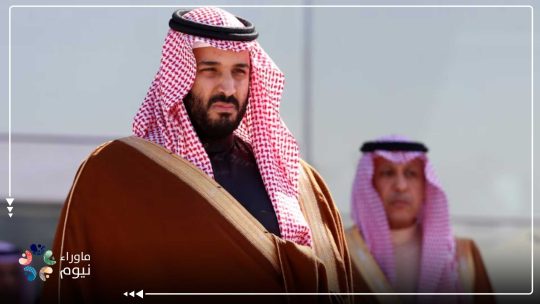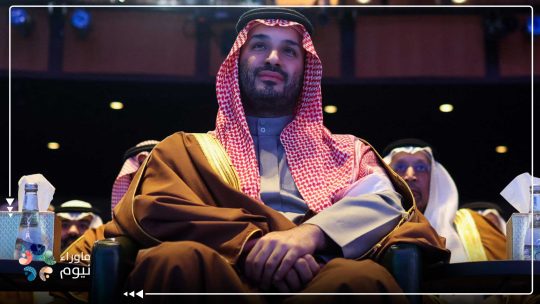

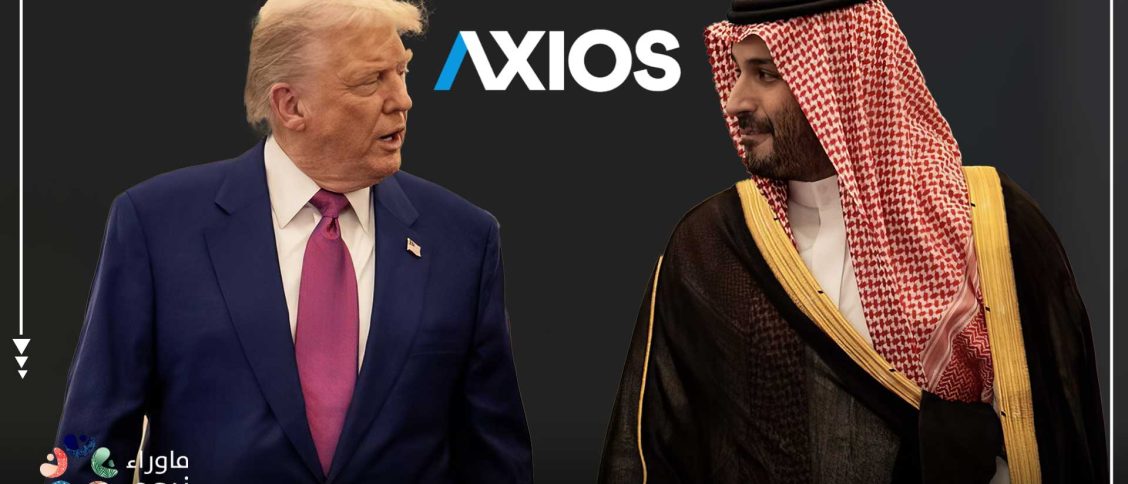
The Saudi media’s reaction to Mohammed bin Salman’s meeting with Donald Trump was swift and unusually coordinated. Not because the encounter produced a diplomatic breakthrough, but because an Axios report laid bare a truth the Saudi leadership has long sought to suppress: the Crown Prince wants normalisation with Israel now, yet remains constrained by a deeply hostile Saudi public mood.
The leak did more than reveal private diplomatic exchanges; it punctured the carefully cultivated image of a decisive leader in full command of his political landscape. Within hours, the Saudi propaganda apparatus moved into overdrive, attempting to recast the Axios reporting into something that aligned with the state’s preferred narrative.
One commentator, “Tamara,” declared that Saudi Arabia had “strongly defended Palestine” during the meeting—a claim entirely absent from the original reporting. Axios did not attribute any defence of Palestine to MBS, but instead highlighted his unease and his acute awareness of popular Saudi anger over the war in Gaza. The attempt was less a rebuttal than an effort to construct a hero where one did not exist.
This was the moment the real battleground became visible: the Saudi regime was not fighting Israel—but the consciousness of its own citizens.
Selective Editing and Manufactured Patriotism
The reframing did not stop there. Odwan, a journalist widely perceived as a semi-official voice for the Saudi state in Washington, altered the language of the Axios report with remarkable freedom. He claimed that the Crown Prince had insisted on an “irreversible Israeli commitment to a Palestinian state.”
This is not what Axios reported. The “irreversibility” referred to the process, not the state—an intentionally vague diplomatic concept that has historically allowed governments to pursue negotiations without delivering substantive political outcomes. The distinction matters. Odwan’s rephrasing transforms a flexible, easily diluted pathway into a firm precondition—an upgrade designed to shield the Crown Prince from domestic accusations of capitulation.
“Saudi Post” went a step further, injecting into Barak Ravid’s reporting words such as “principles,” “justice,” and “steadfastness”—none of which appear in the original text. The purpose was clear: to obscure the central fact that the Saudi leadership has been actively seeking normalisation, not resisting it.
The Admission the Regime Tried to Bury
The most politically consequential line in the Axios report was a direct quote from MBS himself during his meeting with Trump:
“Saudi society is not ready for such a step at the moment.” This was not spin. It was a rare admission that the primary obstacle to normalisation is neither Israel nor the United States, but Saudi public opinion.
What the regime’s defenders attempted to conceal was that the Crown Prince did not express principled opposition to normalisation.
He did not say:
“I will not normalise.”
“I reject normalisation.”
“Palestine is a red line.”
He simply said:
“Not now.”
The implication is stark: the delay has nothing to do with Palestinian rights and everything to do with domestic political management. “Not ready” is not a policy stance—it is an assessment of societal resistance.
The F-35 Boast and the Reality Behind It
During the meeting, MBS reportedly boasted that he had secured a path to acquiring the F-35 fighter jet without having to normalise relations with Israel. It was presented as a sophisticated negotiation victory.
Yet analysts in Israel and Washington have already noted that Saudi Arabia is unlikely to receive the aircraft without formal diplomatic ties—and even then, only in a restricted configuration. The UAE, which normalised in 2020, continues to negotiate its own conditions as an equal partner.
In comparison, the Saudi narrative of triumph appears more like an attempt to mask a strategic vulnerability: MBS would like to follow the UAE’s model—normalisation first, strategic weapons later—but cannot take the initial step.
A Project Not Abandoned, but Postponed
The response to the Axios report was not an instance of mistranslation or journalistic sloppiness. It was a deliberate political act aimed at neutralising a damaging revelation.
Taken together, the evidence points to a clear trajectory:
• MBS wants normalisation.
• He has not ruled it out.
• He is not waiting for Israel—he is waiting for Saudi society to be reshaped.
The propaganda offensive was designed to obscure this reality, to dilute the impact of the leaked admission, and to overwrite foreign reporting with state-approved language. The sentence the regime most urgently sought to bury— “Saudi society is not ready at the moment”— is not an incidental remark; it is a governing doctrine.
It signals a strategy centred on the gradual re-engineering of public opinion through sustained media conditioning until normalisation can be reframed as a patriotic necessity rather than a political rupture.
For the Saudi leadership, normalisation is not a matter of if, but when.
It is a deferred project awaiting the moment when society has been sufficiently softened, managed, and recalibrated to accept it without dissent.
The question, therefore, is no longer whether MBS intends to normalise with Israel—the answer is clear.
The question is: How long will it take to engineer a society that is, in the Crown Prince’s own words, “ready”?