
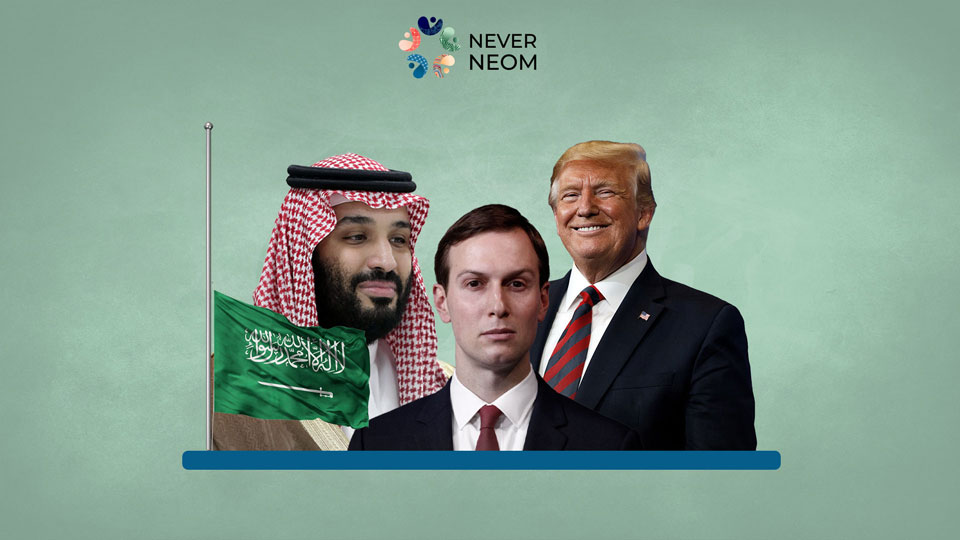
While in the White House, Donald Trump and his son-in-law Jared Kushner cultivated close ties with the Saudi regime, and it’s paying off in the form of billions of Saudi dollars flowing into the two men’s post-presidency businesses. This is raising questions about how Trump and Kushner may have used their positions in government to ensure they profited when re-entering the private sector.
Well-informed sources revealed that Donald Trump and his former senior advisor and son-in-law Jared Kushner are still receiving Saudi financial benefits after serving their time in office.
Shortly after Trump’s term ended, Kushner created a private equity fund for which he needed investors––a seemingly suboptimal situation for someone with little-to-no experience in the private equity space. However, he received a $2 billion investment from the Saudi’s Public Investment Fund, which is chaired by MBS.
Trump, too, has profited from post-White House Saudi investments. Trump closed a deal with a Saudi real estate company to build a Trump hotel as part of a $4 billion golf resort in Oman.
The Saudis provided both Trump and Kushner with sizable investments after their term, during which they bolstered MBS’s grip on the country by arranging that Trump’s first presidential trip be to Saudi Arabia, meeting with him in the US, and siding with him in several controversies, especially after the Saudi journalist Jamal Khashoggi's murder.
Trump’s relationship with Saudi Arabia could cause major problems if he is elected president in 2024. Experts suggest that Trump might be more lenient with the Saudi government because of his financial connections to the country and its leadership.
In addition to Jared Kushner, Trump's Treasury Secretary, Stephen Mnuchin, secured billions of dollars from the Saudi government, in the form of investments in their new private equity funds
The sources affirmed that former Treasury Secretary Steven Mnuchin's Liberty Strategic Capital secured $1 billion.
As Saudi Arabia has long been under fire for its human rights records following the Ritz-Carlton Hotel crackdown and Yemen war, the Saudi funds managed to stop criticism.
According to the Center for International Policy (CIP), the kingdom spent $27 million on firms registered under the Foreign Agents Registration Act (FARA), the legal apparatus for international lobbying, in 2017.
The CIP also implicates Saudi Arabia in illegal spending in the US: Donating to election campaigns. The FARA firms Saudi Arabia paid spent $2.3 million on campaign contributions.
Of those contributions, nearly $400,000 were made to congressmen which the FARA firms had contacted on Saudi Arabia’s behalf. On twelve occasions, the firms contacted the congressmen for Saudi Arabia and made campaign contributions on the same day.
In this regard, Sarah Leah Whitson, the executive director of the Khashoggi-founded group DAWN, has called on Congress to pass legislation to prohibit all former senior US officials from working for or benefiting financially from a foreign government.
Without such a law, she said in a statement, former U.S. officials can “monetize their work for our government into lucrative contracts with foreign governments.