
What was once marketed as a revolutionary model for the future of urban living is now increasingly seen as one of the most striking examples of large-scale financial misallocation in recent years. The Line, the flagship project at the core of Saudi Arabia’s NEOM initiative, has consumed more than $50 billion without delivering a functioning city, a sustainable economy, or even a viable community.
Rather than representing a breakthrough in urban development, the project now stands as a gap between ambition and execution—where vision outpaced planning, and spending outpaced results.
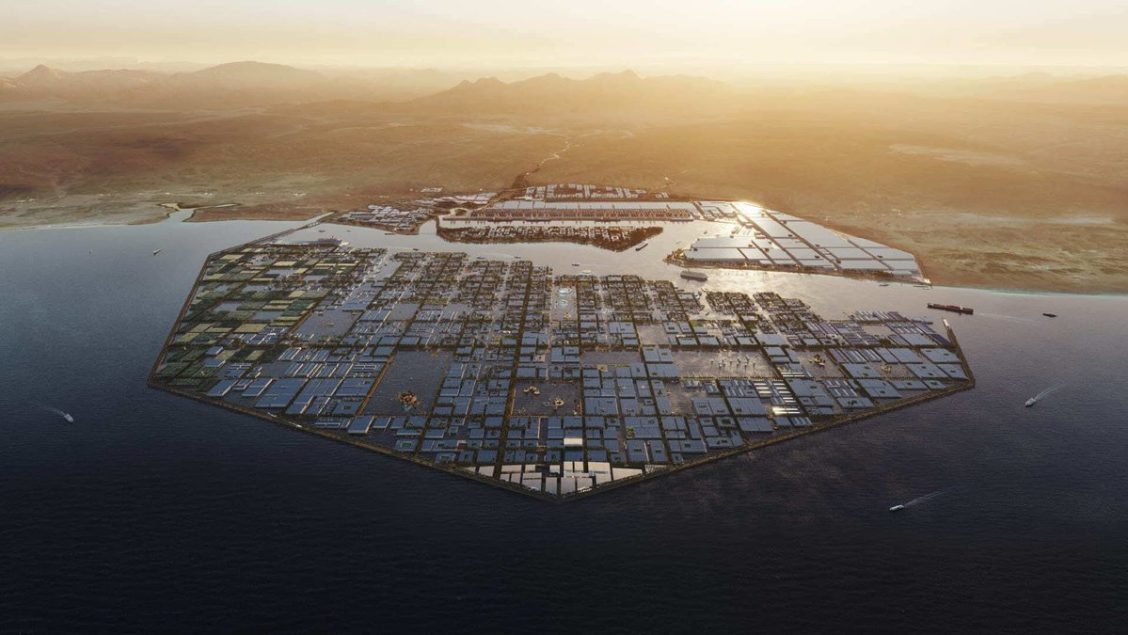
From its launch, The Line was presented as a transformative concept: a linear city stretching hundreds of kilometres, free of cars and built around a new model of living. However, the scale of the idea was not matched by a realistic implementation framework. As funding slowed and timelines shifted, it became increasingly clear that the project lacked a phased, operational strategy capable of turning vision into reality.
By the time financing constraints began to take effect, billions had already been spent. What remains on the ground is largely limited to excavation work and early-stage structures, with no integrated infrastructure, no operational systems, and no signs of near-term habitability.
This disconnect reflects a deeper issue in how the project was structured. Reports covering large-scale developments in the region have pointed to uneven execution, where capital was heavily concentrated in construction activity without a parallel roadmap for sustainability, services, or population integration. As a result, the project progressed physically in fragments, but not functionally as a city.
The scale of expenditure raises further questions. The $50 billion already committed represents not only a cost, but a significant opportunity loss. At that level of investment, multiple large-scale infrastructure networks—transport, housing, utilities—could have been developed across existing urban centres. Instead, resources were directed toward a high-risk, greenfield megaproject in a challenging desert environment.
This pattern is not unique to The Line, but reflects a broader approach within the Vision 2030 framework, where emphasis has often been placed on scale and visibility rather than economic viability. Large announcements have frequently preceded feasibility, creating projects that attract attention but struggle in execution.
Beyond financial considerations, the project has also carried a social cost. The displacement of local communities, including members of the Howeitat tribe, highlights the human dimension of rapid development. With the project now facing delays and uncertainty, the question of long-term justification becomes more difficult: communities were relocated for a development that has yet to materialize.
Structurally, several factors contributed to the current outcome. The absence of grounded feasibility studies at the outset created a mismatch between ambition and capacity. The decision to launch at maximum scale, rather than through incremental development, added complexity and risk. Frequent redesigns and evolving project definitions further disrupted progress, increasing costs while delaying timelines.
Together, these elements produced an unstable development cycle—one in which plans were repeatedly adjusted without reaching a stage of operational stability.
International coverage, including reporting by The Wall Street Journal, has noted that parts of NEOM have already shown signs of slowdown, with some areas resembling inactive construction zones rather than active development sites. These observations reinforce the perception that the project has entered a phase of reassessment, rather than expansion.
Notably, this shift has occurred without a clear official acknowledgment of failure. Instead, adjustments have been gradual—through funding changes, scope reductions, and revised timelines. While this approach avoids direct admission, it has not prevented the underlying reality from becoming visible through data, imagery, and independent reporting.
The gap between narrative and implementation continues to widen. While the project is still presented as part of a long-term transformation strategy, its current state suggests a model under strain.
What remains of The Line is not yet a city, but a case study in the risks of large-scale, top-down development driven by ambition without sufficient structural grounding. The project illustrates a broader principle: financial capacity alone cannot build sustainable urban systems. Without coherent planning, institutional alignment, and phased execution, even the largest investments may fail to deliver functional outcomes.
The trajectory of NEOM now appears less about rapid realization and more about managing the consequences of an overextended vision—one that captured global attention, but has yet to translate into a working reality.