
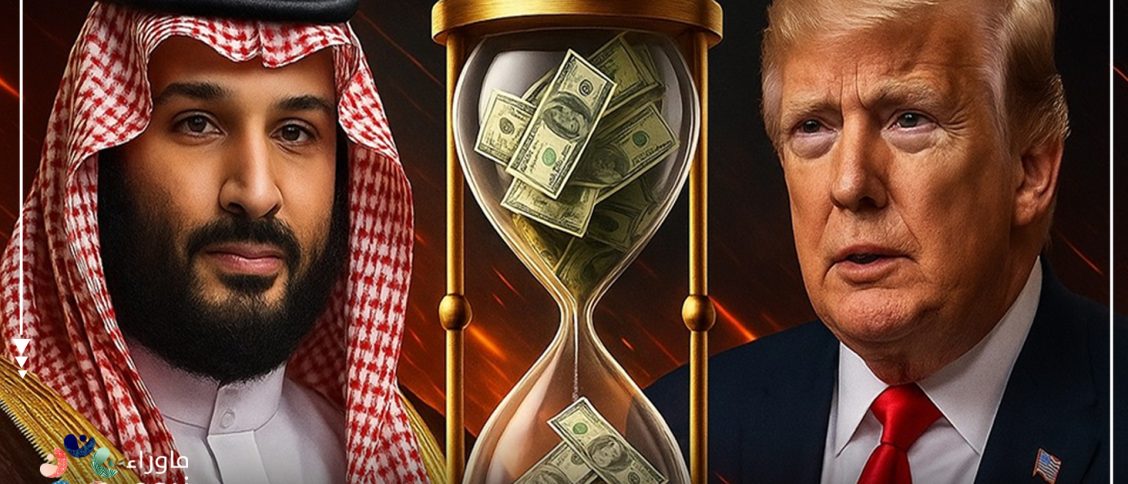
When Mohammed bin Salman emerged from the Oval Office declaring that Saudi Arabia would invest one trillion dollars in the United States, the scene was crafted as a moment of spectacle — a headline designed to dazzle Washington, reassure Trump, and project the crown prince as a global-scale economic force. But once the cameras dimmed, The New York Times published a report that tore through the performance, revealing the truth MBS hoped no one would see: the Public Investment Fund, the financial backbone of his Vision 2030, is suffering a severe liquidity crisis that makes the trillion-dollar pledge indistinguishable from theatre.
Behind the scenes, both Riyadh’s political circles and Wall Street executives are whispering the same line: the PIF is short of cash, and the kingdom cannot meet the commitments it keeps announcing to the world. What took place in Washington was not an economic breakthrough but a large-scale cosmetic operation masking the deepest cash crunch the Saudi sovereign fund has faced since its creation.
A Fund Running on Fumes: Mega-Projects That Consumed Everything
According to The New York Times, the liquidity problem inside the PIF is not speculation — it comes from officials, managers, and financial intermediaries directly involved with the fund. Their accounts reveal the same pattern: MBS and his deputies poured vast sums of state money into extravagant mega-projects now trapped in financial paralysis. These were marketed as futuristic cities and global landmarks, but on the ground they resemble concrete skeletons, half-built resorts, stalled infrastructures, and initiatives abandoned long before maturity.
The PIF, once the crown prince’s preferred tool for pursuing global acquisitions and geopolitical ambitions, has become unable to finance new ventures. Representatives of the fund have told asset managers that any future injection of capital would be tied to rescuing previous failed investments — a sign that the fund no longer acts as an engine of growth but as a distressed asset in need of resuscitation.
The narrative of a “powerful sovereign fund” collapses in face of this reality. What exists instead is a heavily strained entity burdened by reckless spending, ballooning commitments, and domestic projects whose financial scale exceeds what even a petrostate can sustain.
A Stalled Economy: Declining Oil Flexibility and Rising Fiscal Strain
Saudi Arabia’s public messaging insists that the kingdom is “wealthy with oil,” yet the Times report reveals a far harsher picture. Saudi output has been constrained by production cuts dictated by Riyadh’s geopolitical calculations, even as global oil prices fall. This means national revenue — the kingdom’s lifeline — is tightening precisely when state spending is expanding at historic levels.
The Saudi budget deficit continues to grow, and the government increasingly relies on borrowing to fulfil the crown prince’s domestic promises. Brad Setser of the Council on Foreign Relations notes that the PIF’s liquidity shortage is straightforward: domestic obligations have devoured available resources. He adds that Saudi Arabia’s break-even price for balancing external accounts, once around $60 per barrel during Trump’s first term, has surged to between $90 and $100. This shift places Saudi public finances in an extremely vulnerable position.
A country operating under these fiscal pressures cannot deliver a trillion-dollar investment abroad. It struggles even to keep pace with the debts and unresolved commitments generated by Vision 2030 — incomplete cities, stalled rail lines, derelict entertainment zones, and abandoned partnerships once hailed as part of a “new Saudi future.”
From Capital Exporter to Net Borrower: The Shift the Regime Fears Admitting
The Times report is reinforced by an assessment from Bloomberg’s chief emerging markets economist, Ziad Daoud, who argues that Saudi Arabia is no longer a net exporter of capital but a net borrower from global markets. This reversal — from a state that funded the world to one that now depends on foreign loans — signals a foundational failure in the kingdom’s political-economic model.
Daoud also stresses that MBS’s trillion-dollar promise to Trump is unachievable during the current U.S. administration. He notes that transferring large parts of the PIF’s assets to the U.S. is unrealistic and that trade flows between the two countries are far too limited to generate investments of such magnitude.
Which leads to the question the Saudi regime cannot answer:
How can MBS promise the world a trillion dollars while his sovereign fund lacks liquidity, his government borrows at record levels, and foreign debt threatens to exceed reserves for the first time in the kingdom’s history?
The speed with which Saudi Arabia transformed from a lender to a borrower is not merely alarming — it points to the collapse of an entire economic narrative.
The Trillion That Died Before It Was Born — and a Fund Drained by a Prince Without Accountability
The conclusion is stark. What MBS offered in Washington was not an economic commitment but a carefully staged performance meant to project strength before the American administration. The investigation by The New York Times exposes the opposite: a sovereign fund facing unprecedented liquidity shortages, a state experiencing its most acute financial pressures in years, and a leadership trying to mask internal dysfunction with external promises.
The PIF, meant to power Vision 2030, has become one of its heaviest burdens.
The kingdom, once a buyer of global influence, now searches for lenders.
The billion-dollar promises that once captivated audiences now evaporate the moment the press conference ends.
MBS’s “trillion-dollar pledge” collapsed before it even took shape — because the fund behind it is constrained, the economy cannot sustain it, and the pledge was built not on financial fact but on political theatre.
The final reality is unavoidable:
A regime that announces trillions in Washington is the same regime struggling to hide its financial shortages in Riyadh.