
When researcher Rafael Prieto Curiel, a lecturer at the Complexity Science Hub in Vienna, describes The Line as a “mad city, in an extremely poor location, with no water, unbearable heat, and suffocating darkness inside a 500-meter-high concrete jungle,” his words are not a casual critique—they are a scientific blow to a marketing illusion sold to the world as an “urban leap into the future.”
Prieto’s statement opens the door to a wide-ranging critique of a project detached from geographical logic and urban principles—an isolated, enclosed high-tech prison disguised as a futuristic utopia.
The Line: A Glass-Walled Surveillance Prison
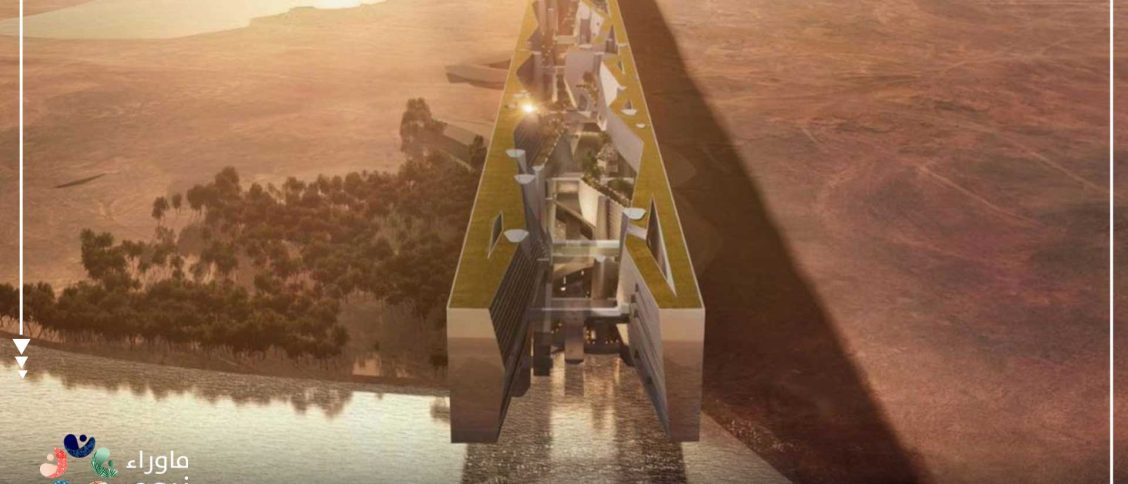
The Saudi regime’s marketed design—parallel concrete walls stretching 170km and rising 500 meters high—is not a city. It is a sealed structure that turns people into “trackable data” within an AI-dominated environment.
- Every movement will be monitored.
- Every financial transaction will be digital and centrally controlled.
- No cars. No open spaces. No spontaneity.
It’s not a space for freedom or creativity, but a closed platform where humans are managed as digital resources under the banner of “future efficiency.”
It resembles a modern-day panopticon: a transparent prison of permanent surveillance, where residents may not feel the chains—but are never truly free.
A War on Nature: The Carbon Bomb of the Desert
While the Saudi government promotes The Line as “eco-friendly,” reality paints a different picture:
- The construction demands millions of tons of concrete and steel—two of the largest contributors to global CO₂ emissions.
- It depends entirely on desalination, a process that drains energy and damages marine ecosystems.
- Located in a barren desert, it will need to import food and energy perpetually, becoming a parasitic city that consumes far more than it can produce.
Building a so-called sustainable city in a waterless, treeless, lifeless desert defies every environmental principle.
Economic Control: A Cashless, Rights-Free Society
Inside The Line, there will be no cash and no free markets. Everything will be managed through a centralized digital economy run by AI systems:
- Every purchase is recorded.
- Every service is algorithmically approved.
Residents will live in a fully closed economy, where the regime controls not only resources but who gets to access them—and who is even allowed to live there.
This is not futuristic freedom. It’s corporate authoritarianism at a city scale—a hyper-controlled society where lives can be paused or erased with the flick of a switch.
Geography Defied: A City Against Nature Itself
The very location of The Line is an urban planning joke. Cities have historically risen near rivers, coasts, and trade routes. But this one is being forced onto a desolate rocky strip, cut off from natural resources and any economic rationale.
As Prieto puts it: “No water. No shade. Crushing heat. Massive walls that block out light and air. How do you build life here?”
It’s an anti-natural experiment—a metallic-glass tube in the middle of the desert trying to simulate life under artificial conditions.
Ghost City of the Future?
Even if the project is completed—a scenario many experts see as highly unlikely—what does the future hold?
- Vast empty zones, unaffordable for ordinary people.
- Half-finished districts due to budget shortfalls.
- Overbearing AI systems watching every breath.
- A massive financial deficit to maintain unusable infrastructure.
The result? A dystopian ghost town, where a handpicked elite lives in luxury, surrounded by sand and abandoned concrete.
A Nightmare Disguised as Progress
Prieto’s assessment sounds like an obituary: “A city with no water, unbearable heat, and suffocating walls… it’s an urban nightmare with futuristic makeup.”
This isn’t a real city—it’s a digital jail built on PR slogans, draining public funds to polish the regime’s image while reinforcing old authoritarian structures with new tools.
The Line: A Mirage Etched into the Sand, Not the Future
Ultimately, The Line is not a city of the future. It’s an architectural perversion designed against both nature and humanity—turning technology into a new form of social control. “When a city becomes a concrete wall in the middle of nowhere, civilisation turns into illusion, and architecture becomes the burial ground of life beneath the glass.”