
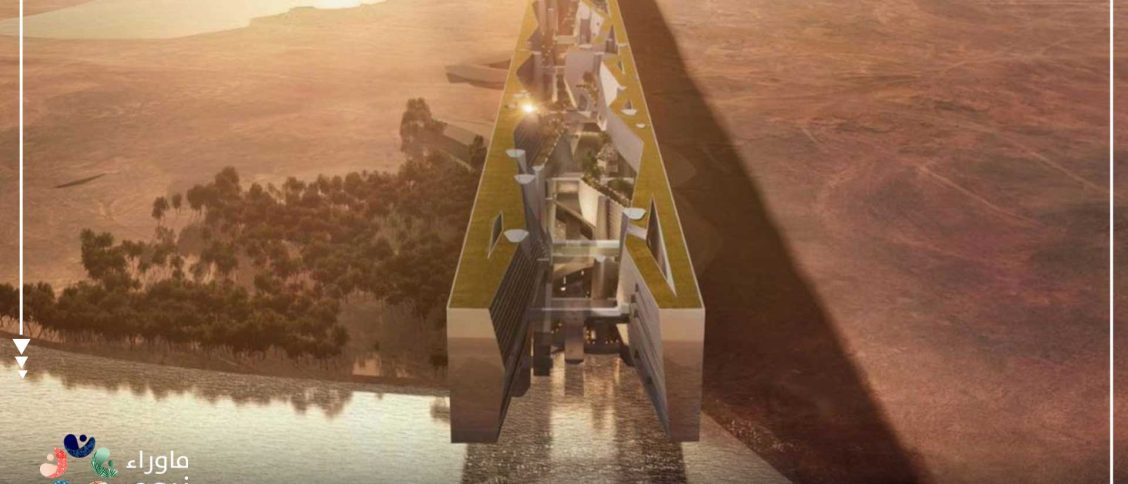
The suspension of work on The Mukaab is not a routine technical adjustment, nor a minor funding review. It is a revealing moment that exposes an entire phase of Saudi Arabia’s economic and political management. A project once promoted as an unprecedented architectural icon—an embodiment of Vision 2030’s ambition to reinvent cities, economies, and lifestyles—has stalled after excavation and piling, leaving behind a question far larger than an unfinished megastructure: how much of this vision was grounded in realistic economic calculation, and how much functioned as speculative spectacle that collapses at the first serious financial stress?
The halt of The Mukaab does not occur in isolation. It follows a growing chain of delays, downsizing, and re-prioritization that began with The Line in NEOM, extended to the postponement of Trojena and the Asian Winter Games, and has now reached the heart of Riyadh itself. This trajectory does not signal “flexibility,” as official rhetoric suggests. It reflects the failure of an economic model built on leaping over reality—launching massive projects without secured returns, then retreating once financial limits become impossible to conceal.
From Power Symbol to Budgetary Liability
The Mukaab was designed to dazzle. A 400-by-400-metre structure, an AI-supported dome, and an immersive virtual interior promising visitors an “alternate reality.” Yet beneath this polished narrative, the project lacked a credible economic rationale from the outset. What exactly would it produce? Who would finance its long-term operation? And what tangible return could justify its enormous cost?
Suspending construction after excavation and piling means the project never moved beyond the most expensive conceptual phase. Funds were spent, contracts awarded, and consultancy and engineering firms benefited—yet the structure itself remains unrealized. This is not an isolated failure but a recurring pattern within Vision 2030 projects: grand launches, global publicity, and belated reassessment once ambition collides with balance sheets.
More significantly, The Mukaab is not a remote desert experiment. It was positioned at the core of New Murabba, in central Riyadh. Its suspension therefore strikes directly at the capital’s image as the showcase of economic transformation, revealing that even flagship, centrally located projects were launched on flawed assumptions.
From Spectacle Spending to Crisis Management
The shift in spending priorities—from futuristic megaprojects toward “urgent” commitments such as Expo 2030 and the 2034 World Cup—cannot be separated from mounting fiscal pressure. Oil prices no longer support simultaneous financing of dozens of mega-projects, and despite its scale, the Public Investment Fund (PIF) has been forced to rein in ambitions after recording multi-billion-dollar write-downs on major ventures.
This exposes a structural planning failure. Vision 2030 was not built on diversified scenarios, but on the assumption of uninterrupted capital inflows. When that assumption faltered, the state was left managing trade-offs rather than executing a coherent long-term strategy. What is now framed as “re-prioritization” is, in reality, crisis management. Had priorities been clear from the beginning, such a volume of megaprojects would never have been launched simultaneously—nor halted after consuming vast resources.
The Public Investment Fund: Development Engine or Spending Vehicle?
The PIF was meant to operate as a sovereign investor generating long-term returns. The experience of The Mukaab and similar projects raises a more troubling question: is the fund functioning as an investment vehicle, or as a financing arm for political and architectural ambition?
The fund’s recent pivot toward logistics, mining, and artificial intelligence reflects an implicit acknowledgment that spectacle-driven megaprojects failed to deliver viable returns. Yet this realization comes at a high cost—capital already spent, credibility strained, and investor confidence weakened. Moreover, redirecting investment does not resolve the underlying problem. These new sectors also require institutional stability, transparency, and genuine risk management—conditions that recent Saudi experience has not convincingly demonstrated.
Social and Symbolic Costs: Jobs That Never Materialized
The Mukaab was marketed not merely as a building, but as an economic engine: hundreds of thousands of jobs, billions added to GDP, tens of thousands of housing units, all tied to a 2030 timeline. Today, that timeline has shifted to 2040, construction is suspended, and promised employment remains theoretical.
This deepens the credibility gap between official discourse and lived reality. Citizens who were repeatedly told of “unprecedented opportunities” now watch projects shrink or stall while living costs continue to rise. Economic success is not measured by conference presentations, but by tangible improvements in people’s lives—something these projects have yet to deliver.
The symbolic dimension also matters. Public criticism comparing The Mukaab’s design to the Kaaba—regardless of one’s position on the analogy—highlighted cultural and social sensitivities toward projects perceived as imposed from above, disconnected from societal identity, and shielded from public debate.
The End of a Phase, and the Questions That Follow
The suspension of The Mukaab is not merely the delay of a single project. It marks the quiet end of a phase defined by governing through spectacle—by assuming that announcing fantastical projects could substitute for economic logic and institutional planning.
With delays and downsizing accelerating, the limits of this approach are now exposed. Saudi Arabia faces a choice: continue rebranding failure as “adaptation,” or confront the deeper reality that Vision 2030 requires structural revision, not cosmetic adjustment. A revision that prioritizes financial realism, aligns projects with funding capacity, and places people—not imagery—at the center of development.
The Mukaab has stopped. The larger question has not: how many more projects must stall before the true cost of this economic path is openly reckoned with?