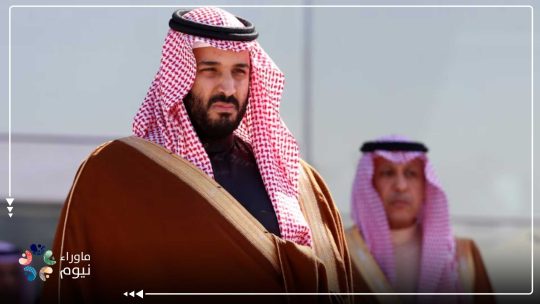

The reality of media repression in Saudi Arabia no longer requires leaks or individual testimonies to be proven. The latest global ranking has formally placed Mohammed bin Salman’s system among the most hostile environments for journalism worldwide. The 2026 report by Reporters Without Borders revealed that Saudi Arabia has dropped to 176th place out of 180 countries in the Press Freedom Index, ranking ahead of only four states widely recognized for extreme repression: Iran, China, North Korea, and Eritrea.
This ranking is not just a number in an international report; it is a political and human rights indicator of what the country has become after years of tightening security control and shrinking public space. More concerning is the pace of decline. Saudi Arabia lost 14 positions in just one year, signaling that the situation is not static but deteriorating further.
The findings directly undermine the official narrative that has attempted to portray “openness” as a comprehensive transformation. In reality, this openness has been limited to entertainment, festivals, and investment-driven spectacles, while journalism remains tightly controlled—more so than at any previous time.
The phrase used by the organization is unambiguous: “There are no independent media outlets in Saudi Arabia.” This description goes beyond traditional censorship and points to a deeper structural issue, where media institutions have effectively become extensions of the state rather than entities capable of monitoring or holding it accountable.
Over recent years, any remaining space for independent discourse has been systematically dismantled. Journalists have either aligned fully with the official narrative or have been silenced through arrest, bans, or intimidation. As a result, the media landscape has evolved into an echo chamber, reproducing state messaging without scrutiny or debate.
This helps explain the sharp decline in the political indicator within the index, where Saudi Arabia ranks 175th globally, dropping 17 places in a single year. The issue is no longer limited to isolated violations, but reflects the absence of a political environment that allows journalism to exist in the first place.
On the security front, where the country ranks 176th, journalism is no longer merely restricted—it has become a high-risk activity. Reporting can lead to imprisonment, enforced disappearance, or systematic harassment. The case of Jamal Khashoggi remains the most globally recognized example, but it is far from the only one. Since 2018, arrests targeting journalists, bloggers, and writers have intensified, making independent expression a genuine risk.
Repression has also extended beyond traditional media into the digital sphere. Individuals have received severe sentences for social media activity, including tweets and online engagement, as cybercrime laws are increasingly used to suppress dissent. This climate has fostered widespread self-censorship. Direct intervention is no longer always necessary—fear itself has become an effective tool of control.
What makes this decline more striking is its contrast with the regime’s massive spending on entertainment, sports, and global media initiatives. Concerts, film festivals, international tournaments, and large-scale investments are promoted as evidence of transformation. Yet international indicators suggest that this change is superficial and selective.
A country ranked among the bottom five globally in press freedom cannot credibly claim openness. The collapse in the economic indicator—where Saudi Arabia dropped 55 places—also reflects how political control has affected the financial environment of the media sector. Media institutions are no longer able to operate independently; they are directly tied to state influence and funding structures.
This means the media sector has not only lost editorial independence, but also its ability to function outside the framework of state control.
The 2026 ranking does not simply reflect a decline—it presents a comprehensive picture of a system that views independent journalism as a threat to be eliminated. Saudi Arabia is no longer categorized merely as a country with restrictions on the press, but as one of the most hostile environments for journalism worldwide.
This trajectory does not appear temporary. It reflects a structural model built on controlling the narrative and eliminating independent voices. In such a system, journalism ceases to function as a “fourth estate” and instead becomes an activity associated with risk and consequence.
What this ranking ultimately confirms is that no amount of international promotion, cultural events, or media investments has succeeded in masking the underlying reality: there is no genuine press freedom, no independent media, and no space for accountability. What exists instead is a large-scale communication apparatus designed to project a modern image, while the truth remains constrained behind security barriers.
When a country of Saudi Arabia’s scale is ranked alongside North Korea and Eritrea in press freedom, the issue is no longer about perception—it is about the nature of the system itself.